OLFACTORY LABYRINTH VER.1

space installation (2013)
 
DATE: September 11, 2013 (wed) – September 29, 2013 (sun)
VENUE: ATSUKOBAROUGH – arts drinks talk
CONTEXT: Sharing Vibes Exhibition
CURATOR: Yukiko SHIKATA
SUPPORT: Yamamoto Perfumery Co., Ltd.

■Introduction - move, smell, and sense –

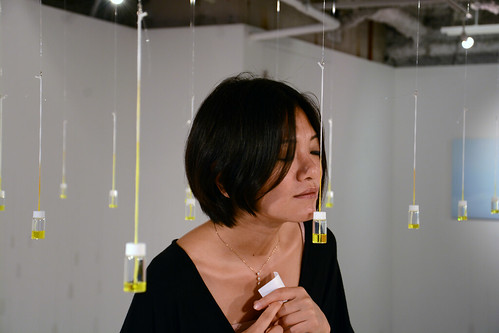
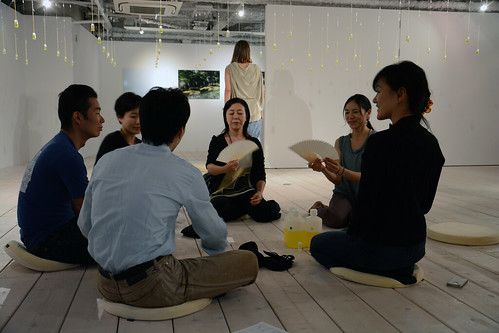
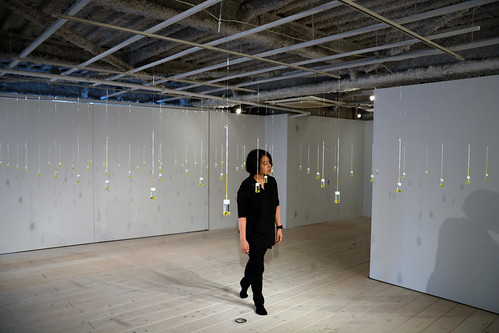
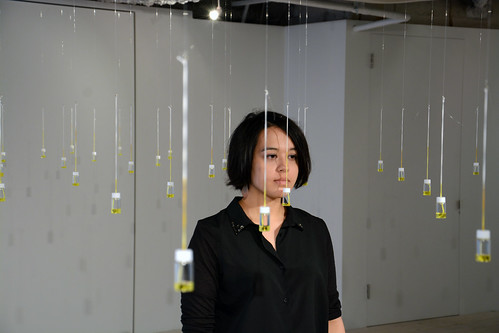
This looks like an installation with bottles hanging from the ceiling in a grid. It is actually a space designed for olfactory exploration.

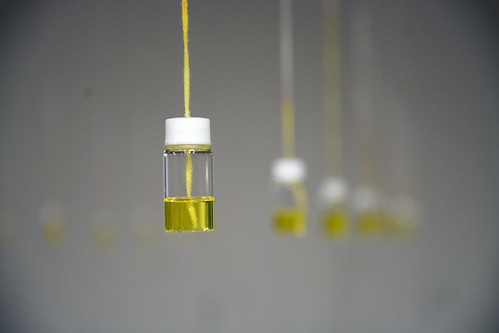
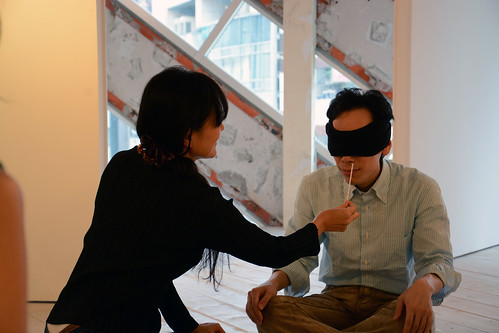
Each bottle contains fragrant oil. The candle rope by which it hangs from the ceiling gradually absorbs the oil and spreads the scent around the space. The oil is just strong enough to be smelled from a 20-cm distance.

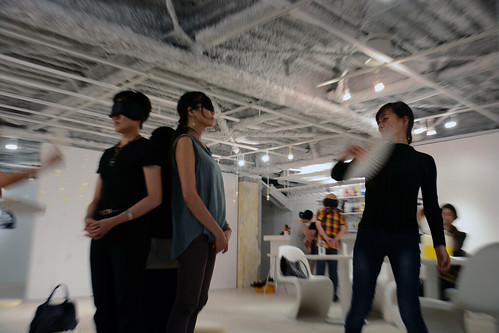
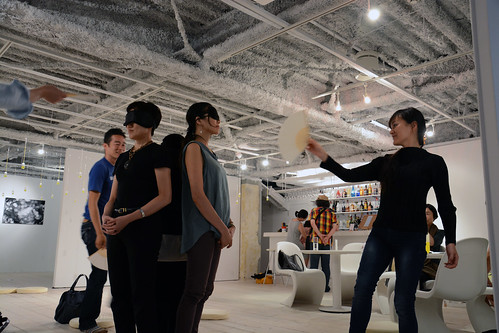
Each grid is about 40 to 50 cm, just wide enough for a person to walk through while smelling.

Three different fragrant oils are used, and they are placed in such way that a person can trace a smell from bottle to bottle. They are placed in clusters or in lines, like a Reversi game. It’s a small, playful “olfactory labyrinth” that also tests your sense of smell.

The construction is flexible, allowing the level of complexity to be adjusted to any target group during exhibition. In this way, it is a platform for experimentation and there is no final, fixed form.

■Focus

The main focus is the olfactory experience rather than the scent itself. Often in olfactory installations or exhibitions, the focus is on guessing a smell or evoking memories and feelings. I think, though, that smell is, in itself, neutral. It’s the audience who attribute meanings such as “I dislike this smell” or “This is the smell I knew from my grandma’s house” after processing olfactory information in their brains. My memories are different from yours, so how can I assume that what is a “sweet smell” to me will have the same meaning to you?

Such meanings to smells are given from personal experiences and histories. This is why I chose not to give meanings to smells in this project. I rather want to be open to surprising olfactory experiences that we normally wouldn’t encounter in daily life. Omni-directional olfactory experience has been forgotten in our modern life, so reviving it is especially interesting. You can become convinced that human beings, much like dogs, have the ability to sniff around and navigate themselves using their sense of smell.

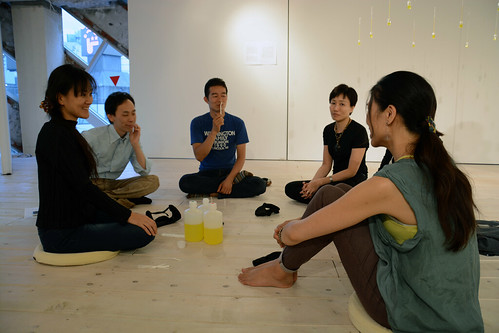
In our society it’s not considered good manners to talk about smell, but it’s recommended to do so here!

■Background

In recent years my key words have been “movement” and “olfactory experience”. I’ve been researching omni-directional olfactory experiences within a certain space. The sensations created by actively walking around and finding smells are very different from just passively receiving smells. I think I’m one of the few artists researching this discipline.

I’ve wanted to make an “olfactory labyrinth” for years. I’ve thought about a big construction in an open space, or an interactive installation with sensors. But I first wanted to experiment at low cost, resulting in this first prototype for future development.

I selected the fragrant oils while wondering how to make a finer resolution of smells within a certain space. Without my sponsor Yamamoto Perfumery Co., Ltd. such experimentation would never have been possible.

I tried to exclude visual and audible aspects in this work as much as possible. I let the work explain itself rather than doing so in words. Instead smells and space communicate with your physical sensations, allowing you to project images and play sounds in the mind. I believe that smell possesses such power.
DSC_0151_adjusted

DSC_0159_adjusted

DSC_0178_adjusted

DSC_0298

[Cutatorial Note]

On “Sharing Vibes: As Part of Resonating Place”

“Sharing Vibes” is presented as a place where we may discover the world anew by starting to recall the diverse invisible and immaterial information―odors, water veins, flows, etc.―that we usually cannot sense, or fail to notice.

It is in this space that Fuyuki Yamakawa, Maki Ueda and Kenshu Shintsubo will attempt to originate a resonance using, sounds, odors, photography and other media. All three avoid confining their works into distinct media or meanings, and instead regard them as potential information so to prompt us to open up our perceptions and thinking.

Yamakawa showcases a new work that makes underground water flows audible and visible. The research he carried out to create this work will also be presented in the form of a portable map that visitors can take with them in order to feel the water veins in Shibuya. Ueda’s “labyrinth” composed of multiple odors is a place where each person gives active attention to the sense of smell. Shintsubo’s works vividly capture the phases of water that circulates the world through the atmosphere and trees.

The mutual interaction among the works,the mutual influence between those who share the space, and the new vibrations that are born through the multiple resonances between the space, the works and the people… A place each of us participate as a part of the exhibition, of the space and of the world. “Sharing Vibes” does not end.  (Yukiko SHIKATA, Curator)

NEXT—> WORKSHOP

THE EARTH PERFUME

smell the environmental changes

research art (2014)
FUNDING: Centrum Beeldende Kunst Rotterdam O&O subsidy
COLLABORATOR: Aastha Chauhan
th_DSC_1863

DSC_1865 copy

Overview

The final goal of this project is to make “The Earth Perfume” of the Dutch harbour city Rotterdam by means of distillation. The result did not smell good. But I accept that. Rotterdam is an industrial city located downstream of the River Rhine, where contaminated water and air flows in. Scents do not lie. The truth is represented in the work.

Each earth represents its local scent.  No one smells the same.  Microorganisms and vegetation of the area and the degrees of contamination appears in the scent of the earth.

The scent of so-called the first drop of rain – that’s what I am aiming to capture and make perfume out of it.

Background

This project started with an email that arrived from India one day.

“Hello. I’m Aastha from India. I was interested in your works.  My grandfather was a perfumer. In India, a traditional way of distilling and making perfume is still being practiced, but disappearing. Do you want to learn it together?”

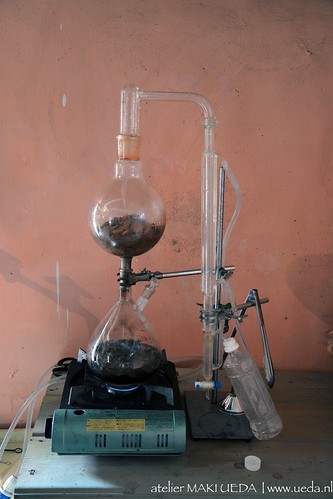
In India, from ancient times about 5000 years ago, long time before alcohol-based perfumery was developed in France, oil-based distillation and perfumery has been practiced.  The perfume oil is called Attar. There are roughly 30 types of Attar nowadays, mostly made from common plants and flowers like rose and jasmine. To my eyes “The Earth Attar” seemed to be interesting. I also made an attempt to extract the scent of the earth in Western distillation method many times, and had failed. So “to learn the distillation method for extracting and making the perfume of the scent of the earth”, I applied a grant to the Rotterdam City Art Center.

Encounter to the perfume house in Kannauj

In April 2014 I visited Kannauj, a small town along the Ganges River which is located about 200km southwest from Delhi. It’s a town known as the city of perfume and Attar making. In the middle of election campaign, it was a journey with tensions where tempted civil soldiers were walking around with guns. 

Aastha had visited Kannauj prior to my visit with her grandfather’s old diary hoping that she would find some grandfather’s footage in the town.  The Perfume House that her grandfather’s friend was running was alive, and the grandson was the current owner. “My grandfather was your grandfather’s friend!” The owner, Mani accepted her, and helped out our project.

Mani gave me all that he could show me over a period of 3 days, not only information but also materials. It was quite unusual in the world of Indian conservative perfumery.

How they make Attar

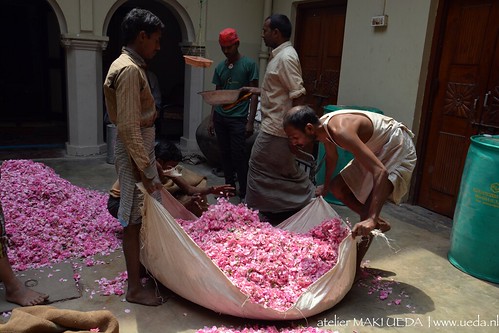
Incredible scene was waiting behind a small gate in the backstreets of Kannauj. In the courtyard, there was a pile of rose petals. Like Cleopatra’s bedroom. Later I got to know that it was arranged especially for our arrivals by Mani.

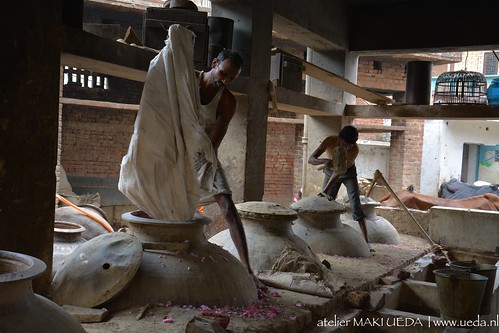
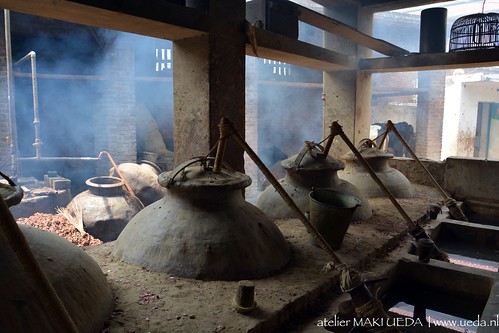
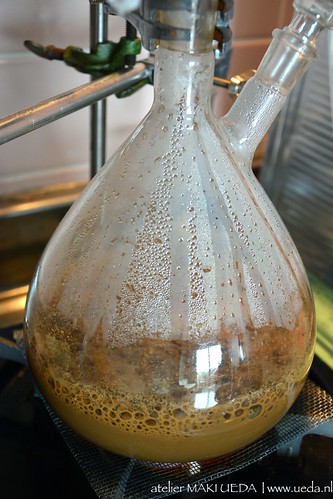
His staff pack the petals in jute bags for weighing 10kg. They carry them to the backyard, and throw them in distilling pot that had been pre-filled with water. They close the lid, and put it on fire. Solid block fuels made from cow dung are used here. To take care of cows is also part of their work.

The cooling pot is always exposed to running water. In the pot  “base-oil” sandalwood oil is waiting for the drops of cooled water. It contains the rose aroma.  It goes through the membrane of sandalwood oil and the rose aroma is adsorbed in sandalwood oil.

If you leave it running, the cooling pot gets full. Then, cooled water is collected through the hole on the bottom of the cooling pot (thus the layer of sandalwood oil is left intact) and recycled back into the distilling pot. The next day, the rose petals are replaced, and the same process is repeated. Having continued this for 4 to 5 days, the intensity of the fragrance gets increased.

Difference between Indian Attar and Western perfumery

The perfume houses usually have secret family recipes. On that day that I visited, in addition to The Rose Attar, “Hini Attar” was in the process.  Having used more than 20 kinds of herbs and spices, it smells animalic like amber and quite spicy. Raw materials are thrown into the distiller before putting on fire. This means, making corrections later is no longer possible. This is very different from the Western-style.

In the Western-style, a “aroma palette” is first made by distilling materials one by one separately, and then mix them later. In other words, you can make corrections later as much as you want. In the case of Indian Attar, all is determined by the first formulation. Natural elements also affect the result: the quality of the cow dung as fuel, thermal power adjustment, the temperature of the cooling water, and temperature of the aging period, etc. This requires experiences and intuitions: it’s like magic.

The surprising relationship between The Earth Attar and tea house

The surroundings of Kannauj is amazing.  The earth of dry red soil continues forever. When we were almost approaching the town, we took a rest at one of the chai places that you could find roadside anywhere.

In the center of the teahouse the master was making hot water with charcoal. How many cups of chai would he be brewing per day sitting there? It was not just a cup of chai, but the carefully brewed one. I took a sip. The first notice was the smell of the earth. It is the scent that rises from terracotta cup. The dry, robust scent was coloured by the scent of spices and tea. Smooth taste of milk warmed the mouth.

Terracotta cup is for one-time use only and disposed. A potter makes them usually next to the teahouse. Since the water is very valuable, it’s probably more efficient to throw it away than washing it. The cup returns to the earth. It’s 100 percent bio-degradable.

Thus a cup of chai and the earth has an inseparable relationship. Indians taste and drink the earth on a daily basis. And I got to know then that The Earth Attar is made from the  terracotta pottery. In place of rose petals, you use teracotta.

Mani said “If you spit water over the soil, there is the scent that rises that moment.  Don’t miss that moment. It is not a very strong smell. Replace the materials many times when distilling, so that the scent gets more intensity.”

Mani gave me The Earth Attar that his friend made. It was very dry scent, reminding me of rough and vast ground around Kannauj.

The Earth Attar of Okinawa (Ishigaki Isl.)

Having learned the technique in India, new question arose. How to make terracotta from the soil then? It was an unexpected problem. I have no pottery experience, and not even able to tell the clay suitable for making teracotta from. However in Okinawa where I run a second studio, pottery making is a popular traditional art. So I visited potters and learned the way roughly. My friend who was the nature guide helped me with collecting the red soil from the riverbank.

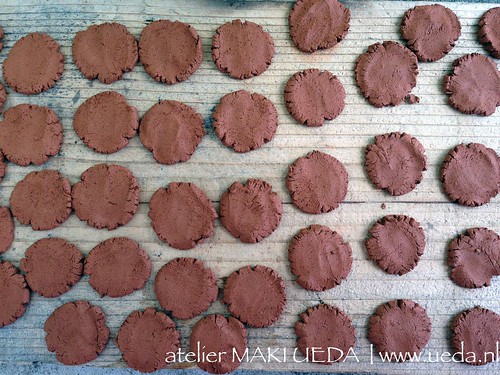
I do not have to describe the whole process here but I did make teracotta from the earth as potters would do. Then I made a number of coins for the size of the distiller. It was the process that took many many days.

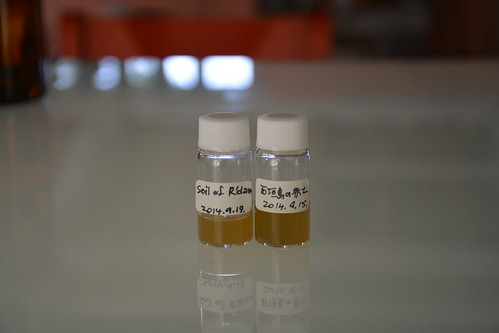
Then, I applied the method I learned in India for my equipment. Over a period of several days, sometimes leisurely on the wood stove, I continued distillation. So was “The earth perfume of Okinawa” developed. It was a refreshing scent somewhat dry, reminding me of a strong sunlight in the summer.

The Earth Attar of Rotterdam

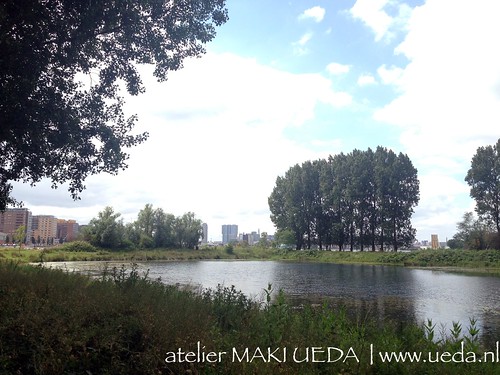
Now is the Rotterdam’s earth. Since the clay is often found at the riverbank, I went to the Brienennoord Island in the middle of the river Maas (the downstream of Rhine) that flows through the center of Rotterdam. In the groomed beautiful park, I packed the earth in my car.  I must have been a suspicious person. I filtered it, made terracotta clay, shaped coins, and then distilled them. Since Rotterdam is close to the sea, the earth contained a lot of sand, which made shaping coins quite difficult.

The scent of The Earth Attar of Rotterdam was like “dead microorganisms”. First notice is the pungent smell. It’s like rotten smell of protein. Since the river is polluted and nutrient rich, microorganisms are also rich. Compared to the Okinawa one, the smell is heavier. Smells do not lie. But once its first scent disappears, the warmth of sandalwood oil appears. 

Future plans 

This project was already getting attentions in the olfactory art scene. Especially an active curator in this scene, Caro Verbeek, showed her interest. I would like to find the venue for “premier” of this work.                                                                                       

In Delhi we (together with Aastha) are planning an exhibition with the result of our porject, with probably more olfactory works from me.  An alternative gallery KOHJ showed their interest already.  We have talked to The Dutch Embassy and The Japan Foundation about the idea, and they showed their interest to support the exhibition.  This will be happening in the year 2015.

th_DSC_1149


th_DSC_1185

th_DSC_1241

th_IMG_1961

th_IMG_1630

th_DSC_1757

th_DSC_0878
th_DSC_1723

DSC_1851 copy