A Participatory Multispecies Environment of Chemical Signals
Exhibition Guide
We recommend reading this information after walking through the Olfactory Biome with your nose.
SCENT MAP:

[A] Powder Puff Tree
MOTH 🦋 For you, this can signal a potential food source. (Some Calliandra species are visited by hawkmoths.)
BAT 🦇 For you, it can signal a potential food source. (Some Calliandra species are pollinated by nectar-feeding bats.)
HUMAN 👤 For you, it is a creamy sweet, floral scent. It is also associated with the tropical landscape of Ishigaki Island, Okinawa, where the artist lives.
[B] Thymol
MOTH 🦋 For you, it’s a warning or interference signal. (Thymol has been shown to disrupt pheromone-mediated attraction in some moth species.)
BAT 🦇 –
HUMAN 👤 For you, it can stimulate the trigeminal system and produce a mild cooling sensation.
[C] Isoamyl Acetate
MOTH 🦋 For you, this fruity odor may be a warning sign that bats (potential predator) could be nearby.
BAT 🦇 For you, this can signal a potential food source. (Fruit bats have been shown to detect and discriminate isoamyl acetate and other volatile compounds found in fruit.)
HUMAN 👤 For you, it is banana. Sweet, fruity, familiar, and edible.
[D] Coumarin
MOTH 🦋 For you, this is not necessarily an invitation. (Coumarin can act as a deterrent to oviposition in some moths: “Do not lay your eggs here.”)
BAT 🦇 –
HUMAN 👤 For you, it is sweet, powdery, and warm. It may evoke hay, vanilla, or cherry blossoms.
[E] Birch Tar EO
MOTH 🦋 It is not a known moth-specific signal, but it can function as a warning of possible danger for you.
BAT 🦇 For you, it can signal potential fire and danger. Bats can detect smoke and may respond by becoming alert and escaping.
HUMAN 👤 For you, it can signal potential fire and danger, and for some of you, peat in Whiskey.
Scent Map | Olfactory Biome | Maki Ueda
[F] Queen of the Night
MOTH 🦋 For you, this can signal a potential food source. But it may also mean that bats (your predator) could be nearby.
BAT 🦇 For you, this can signal a potential food source. (Bats have been reported visiting Epiphyllum oxypetalum, although moth pollination is better documented.)
HUMAN 👤 For you, it is powerful nocturnal citrusy-floral scent. It is also associated with the tropical landscape of Ishigaki Island, Okinawa, where the artist lives.
[G] cis-3 Hexenol
MOTH 🦋 For you, this green, crushed-leaf smell can tell you that a plant has been damaged. If you are a female looking for a place to lay your eggs, it may mean: “Someone is already eating here. This may not be a good place for my offspring.”
BAT 🦇 –
HUMAN 👤 For you, it smells like freshly cut grass. Green, crushed, alive.
PLANTS 🌱 For you, this can be a warning:“Someone nearby is being eaten.” Plants can detect green leaf volatiles released by damaged neighboring plants and activate or prime their own defenses.For you, it smells like freshly cut grass. Green, crushed, alive.
[H] Isoamyl Acetate (The same as [C])
MOTH 🦋 For you, this fruity odor may be a warning sign that bats (potential predator) could be nearby.
BAT 🦇 For you, this can signal a potential food source. (Fruit bats have been shown to detect and discriminate isoamyl acetate and other volatile compounds found in fruit.)
HUMAN 👤 For you, it is banana. Sweet, fruity, familiar, and edible.
[I] Eugenol
MOTH 🦋 For you, this can signal a potential food source. It may help you locate a flower that could provide food.
BAT 🦇 –
HUMAN 👤 For you, it smells of clove, spice, and perhaps dental products.
[J] Indol
MOTH 🦋 For you, this can signal a potential food source. (Indole can attract hawkmoths to flowers and function as part of a floral signal.)
BAT 🦇 –
HUMAN 👤 For you, at low concentrations it can smell like jasmine, white flowers, and sensual sweetness. At higher concentrations, it can smell fecal, decayed, or dirty.
PERFUME BOTTLES:
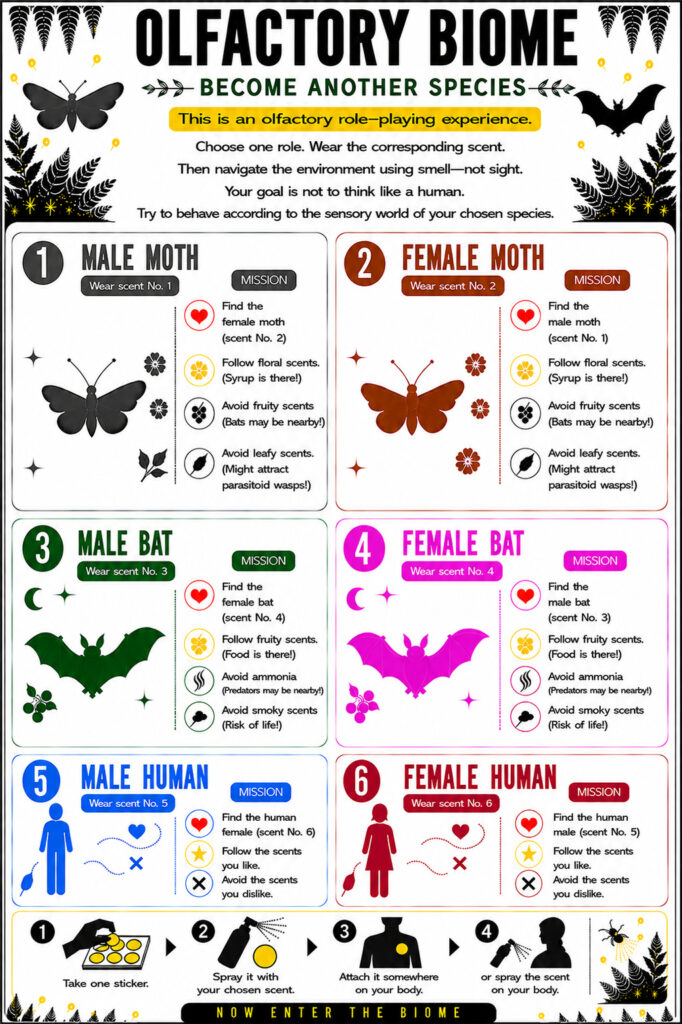
No.1 Male Moth: Linalool
Linalool is a typical floral scent found in many flowers and fruits.
For moths, linalool can be part of the complex scent signals that help them locate flowers and potential food sources.
No.2 Female Moth: α-Ionone
α-Ionone is a typical powdery, violet-like scent found in many flowers.
It occurs in the floral scents of plants that rely on pollinators, and can contribute to the scent signal that guides insects to flowers.
No.3 Male Bat: Ethyl Vanillin
Ethyl vanillin has a sweet, vanilla-like, gourmand scent and is widely used as a flavoring.
Its smell is much stronger and more familiar to us as “vanilla” than the scent of natural vanilla beans. For a bat, however, this is simply another chemical cue to be interpreted through its own sensory world.
No.4 Female Bat: Gamma Decalactone
γ-Decalactone has a sweet, fruity, peach-like scent.
It is also found in human body odor, including the scent of young women. The same molecule can therefore connect two very different olfactory worlds: fruit and the human body.
No.5 Male Human: beta-Androstenone-like
β-Androstenone is a steroid-like compound associated with mammalian body odor and has been proposed as a potential pheromone in humans.
In male pigs, androstenone is a well-established component of the boar’s sexual odor and can influence the mating behavior of females.
For humans, however, its role as a pheromone remains uncertain.
No.6: Female Human: Copulins-like
Copulins are a mixture of volatile fatty acids associated with the vaginal odor of female mammals.
Their composition can change during the menstrual cycle and has been studied particularly in relation to the odor of rhesus macaques around ovulation.
Whether copulins function as a pheromone in humans remains controversial.