EDIBLE PERFUME

– extraction & composition of flavours –

workshop (2008)
 

12

Food pairing, a widely accepted concept in the molecular gastronomy scene, explores the potential of unacquainted food combinations – grapefruit with cardamon, carrot and bitter orange peel – to create new tasting experiences.

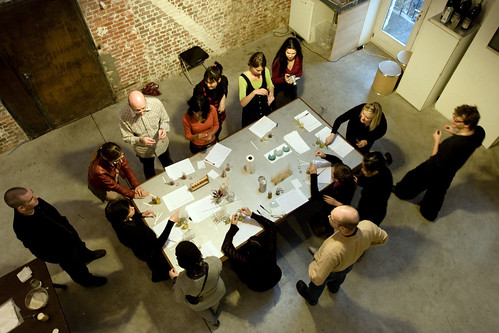
Maki Ueda developed her own mysterious ways of extracting smells from raw materials in a kitchen environment throughout her career. As artist in residence at FoAM, she was challenged to share her fascination in a hands-on workshop focusing both on smell and taste. Could both ways of sensing be combined with the art of composition in perfumery, the art of finding the right matches and balancing between hundreds of aromatic ingredients?

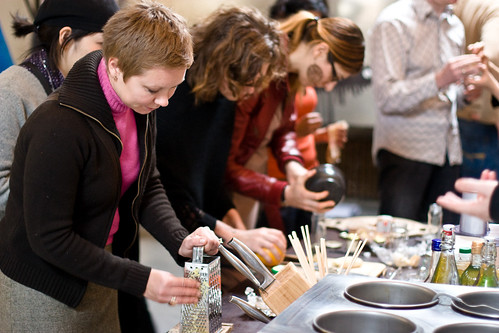
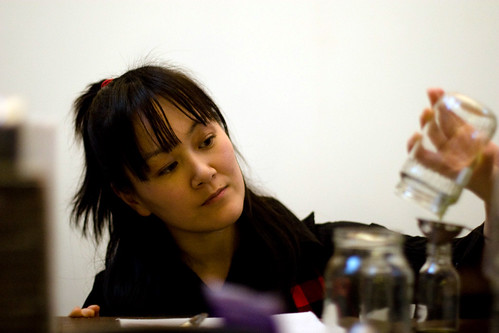
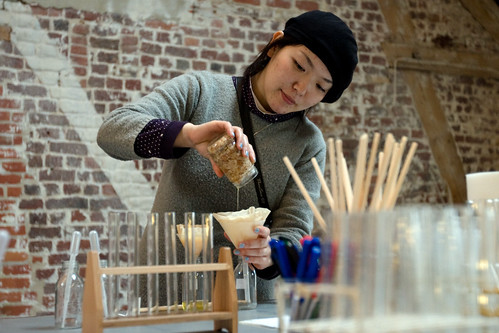
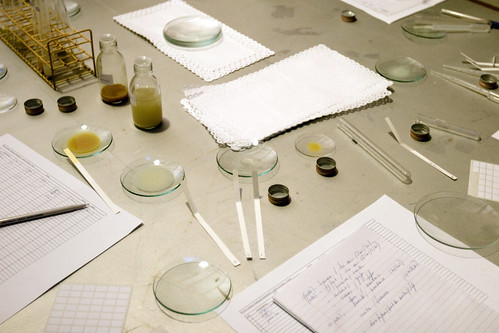
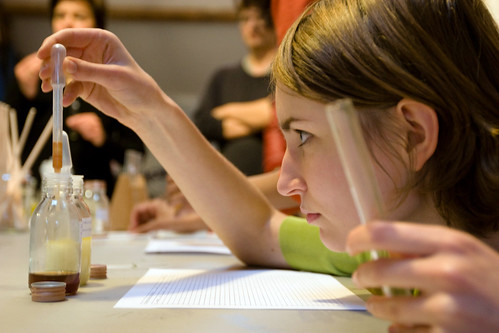
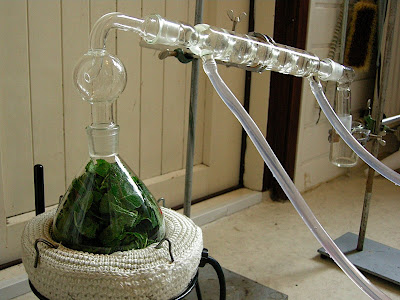
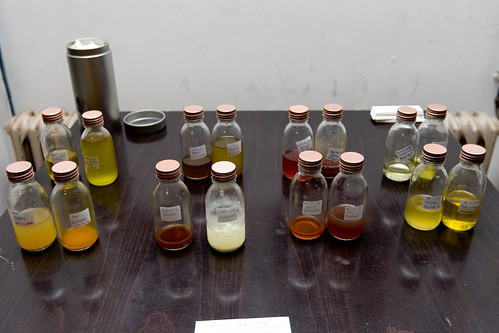
A natural smell is often extracted from a material using chemistry techniques for retrieving essential oils, such as distillation, ethanol extraction, or oil maceration. For the Edible Perfume workshop, these techniques were adopted in the kitchen. In a temporary laboratory setup, the participants experienced the complete process of extracting aromas and flavours from edible raw ingredients, in order to recompose them into new culinary substances.

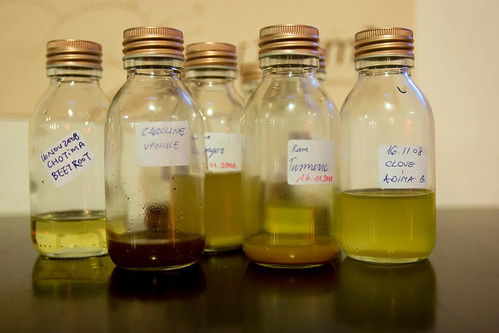
Every participant was asked to bring two edible materials: a ‘he’ and a ‘she’ as part of a food couple. Each material was to be extracted separately and then mixed together into one edible perfume. The challenge for the participants was to find the right balance of the two elements , giving birth to complex and surprising scents; the children of the ‘he’ and ‘she’ ingredients.

The following food couplings were created during the workshop:

  • almond & grapefruit 
  • cardamom & orange 
  • vanilla & parmesan 
  • star anise & banana 
  • clove & mandarin 
  • ginger & turmeric.

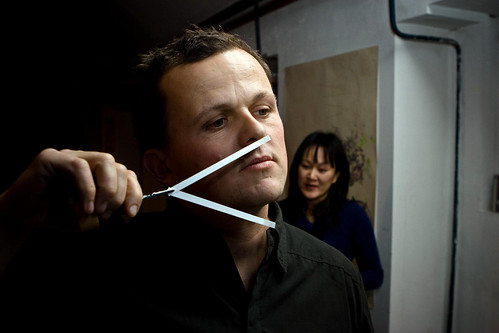
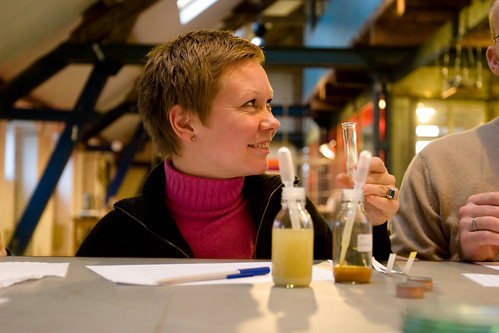
The participants have witnessed the process in which the aromas get separated from the tissues of the materials and absorbed in the medium. The result was evaluated both by smelling and tasting.A lively discussion ensued – where does our sense of taste and flavour originate; what is this mysterious area linking the cavities of our noses and mouths that can sense such subtleties of aromas and flavours? The group agreed that he sensation of edible perfume created was neither taste, nor smell alone, butsomething ephemeral, an experience in-between the senses.


EXTRACTION
01

07

06

03

02


COMPOSITION (FLAVOUR COUPLING)
10

08

11

04

05

TASTING

09

14

13jpg

DO IT YOURSELF – 5 STEPS

1. Process the material and make it as fine as possible

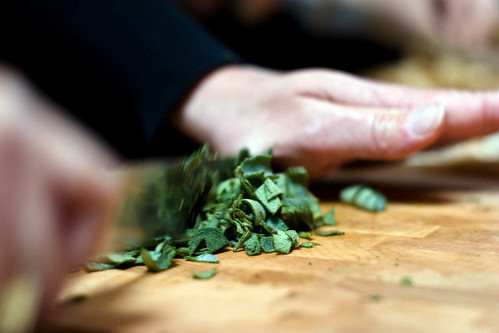
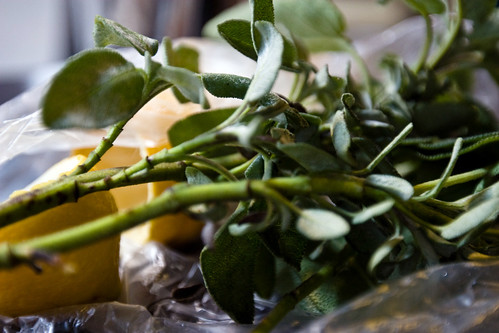
Use whatever tool you can find in a kitchen to peel, crush, shred or cut the ingredients into the smallest possible particles. The smaller the particles, the shorter the extraction time.

2. Choose the right medium and right temperature

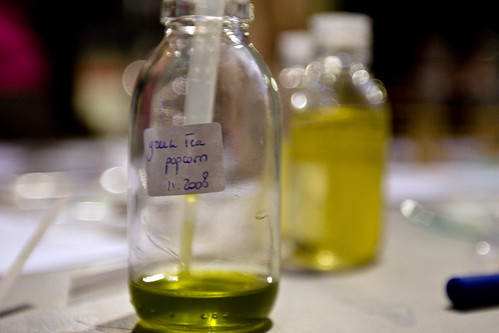
There are different ways of extracting smells in general: such as distillation, hot/cold maceration, solvent extraction, enfleurage. The most appropriate technique to apply is hot / cold maceration, common for making garlic-flavoured olive oil. In order to make the extracts ‘edible’, 40% VOL vodka or non-flavoured, odor-neutral vegetable oil can be used as a medium. We used Grapeseed and soy oil. Vodka or oil can only extract a part of the whole bandwidth of smells that the ingredient contains.

Extracting temperature is another factor. Certain temperatures can extract certain bandwidths of smells, depending on the ingredient. Experimentation is the message!

3. Stuff it in a jar and heat it for 1 hour

Place your ingredient in a jar, pour vodka or oil over the material (not too much, just enough to cover the surface), close it half way and heat it au bain-marie, keeping 70 degrees Celsius. 70 degrees is the temperature where oil does not change its flavour and is just below the boiling point for vodka. (Use an electric hotplate for heating because vodka is flammeable.)

In case of citrus and orange – which cannot resist the heat – they should just be mildly shaken in the jar at room temperature. The time needed for extraction depends on the material, however 1 hour is generally more than enough to extract enough amount of smell molecules for your nose and tongue to detect.

4. Filter it

Use a coffee-filter. If the particles are too fine for the filter and cause clogging, rough cotton cloth could be used instead. Stirring can accelerate the process, but it can also introduce impurities in the resulting liquid, so the best thing is just to wait, time allowing.

5. Compose the smells

Should mix ratios be 1:9 or 4:6? There’s no universal answer, indication nor rule here. This is where your creativity comes into play. Use your nose and intuition to explore and experiment. To check the result, you can lick it, but smelling it from a paper perfume strip is the best, as smell molecules tend to linger around longer in your mouth than in your nose. If your nose gets confused, smell your own skin to refresh it.

You can enjoy the ‘edible perfume’ with bread, cracker, or oblaat. Toast!

NOTE: keep your lab well aired. In case you get nauseous, go for a walk in fresh air, and drink a glass of milk.

(edited by: FoAM)


REFERENCES

Food pairing:

http://www.foodpairing.be/

http://khymos.org/pairings.php


INFO FOR PARTICIPANTS

documentation by FoAM:

http://fo.am/edible_perfume

instructions for participants:

http://lib.fo.am/edible_perfume


DEVELOPMENT

For the documentations of its development and the workshops given all over the world :

http://scent-lab.blogspot.com/search/label/%5Bedible%20perfume%5D


CREDITS

concept, realization : Maki Ueda

production : FoAM Brussels

premier : Open Kitchen / Open Sauces


OPEN SAUCES

– a technical and social food art event –


date: Nov. 22, 2008

concept, realization: FoAM


THEME


  • open source & open sauces
  • the sense of taste & the sense of smell
  • food crisis, trading, logistics,
  • future of the food etc.etc…
  • Not to forget: to taste!

photos by: Alex Davies


CONCEPT

http://fo.am/open_sauces

2008-11-22 18:00 Europe/Brussels
2008-11-22 23:00 Europe/Brussels
Location: FoAM Lab, Koolmijnenkaai 30-34 Quai Des Charbonnages, B-1080 Brussels, Belgium

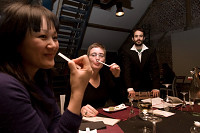
FoAM and the Guild for Reality Integrators and Generators invite you to a synaesthetic dinner, to jointly sample, celebrate and debate the future of food.

Food is a nutritious and delectable product of our reciprocal, sustaining relationship with the environment. It is also one of the oldest cultural expressions, rooted in hospitality and sharing. As the gastronome Brilliat-Savarin noted three centuries ago, “the discovery of a new dish does more for human happiness than the discovery of a new star.”

Open Sauces will unfold in a sequence of experimental courses, matched with drinks, improvised music and esteemed guests. While savouring the foods, the guests will be engaged in table conversations, sharing experiences, recipes and ingredients needed to demystify cultural, environmental, technical and ethical aspects of contemporary food systems. From molecular gastronomy to fair trade, from permaculture to food-tracking, from open source to open sauces, we will blend seemingly unrelated elements of our food chain. In an era riddled with environmental and cultural anomalies, these transdisciplinary and trans-local connections will become one of the keys to our survival, as individuals, communities and species.

With: Alexandra Deschamps-Sonsino, Kultivator, Sher Doruff, Maja Kuzmanovic, Alok Nandi, Sneha Solanki, Wietske Maas, Matteo Pasquinelli, Kate Rich, Femke Snelting, Andreas Strauss, Maki Ueda, Allison Zinder and other local and trans-local food experts and enthusiasts.

There are limited places for this event so please RSVP if you would like to attend.

The extended menu (in the form of a cookbook) is available online at http://opensauces.cc/open.sauces.pdf


MY CONTRIBUTION

Green Peas & Mint Soup

15 11 10


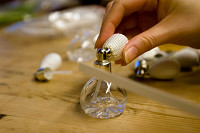
  • gaseous <—- the perfume dish that I contributed
  • fluid
  • (half)solid


It was my role to give a toast for this course. (The toasts were related to the each course.) My toast:

If you pinch your nose when you eat, you wouldn’t taste much flavors. The role of smell is quite crucial in cookery, because 70 % of tasting is said to be smelling. The rest 30 % is saltiness, sweetness, sourness, bitterness, umami, and some texture. The smell or aroma of the food comes in to the nose through the nose holes, but also from the back of the nose by chewing. Good test would be to chew the food with the mouth open. You wouldn’t taste much. This transparent liquid in the perfume bottle is distilled green pea & mint soup. The aroma’s of the soup is condensed and concentrated in this liquid. In other words, it’s the same liquid that you can also find on the lid. Now, what happens if we don’t close the pan when making a soup? You might find an answer in this perfume. You can spray it in your mouth.


DEVELOPMENT

http://scent-lab.blogspot.com/search/label/%5BOpen%20Sauces%20%7C%20FoAM%5D


REFERENCES

Food pairing:

http://www.foodpairing.be/

http://khymos.org/pairings.php


OPEN SAUCES BOOK

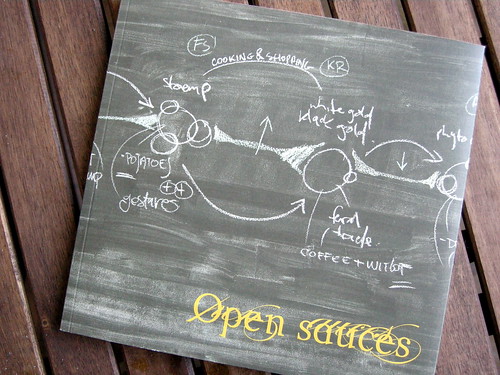
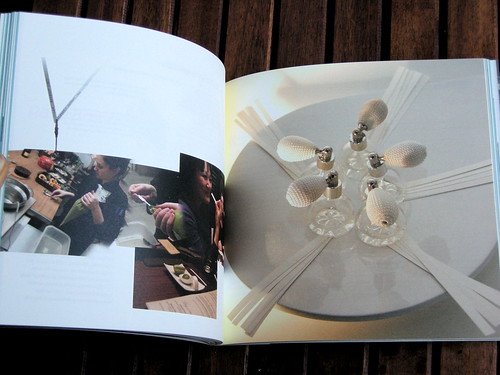
A book that covers the whole evening of memorial dinner event Open Sauces is published.

DSCN9535

DSCN9536

ISBN 978-90-810733-0-1

 download the electronic edition of the “Open Sauces” cookbook in PDF: http://opensauces.cc/open.sauces.pdf

  • with full recipe of the evening
  • with full recipe of Edible Perfume Workshop
  • with full recipe of “green peas and mint soup – gaseous, fluid, solid -“
  • it’s a MUST have book for those who are interested in molecular gastronomy, food art, and cooking with scents in priority


From the introduction…

This book is designed as a collection of the “toasts” and their accompanying recipes from the Open Sauces dinner. It is a scrapbook – a “common-place book” in the parlance of earlier centuries – and a book of commons. Commons, a term denoting shared public resources, can be traced back to the sharing of provisions, of rationing limited amounts of foodstuffs to feed a whole community. Similarly, Open Sauces offers bite-sized morsels of diverse aspects of contemporary food culture – whether curious information, case studies, or specific techniques – to feed a diverse group of readers. The book also contains the recipes for the complete, seasonal Open Sauces menu, designed for twenty-five people. The recipes list the original amounts; however, as each course was quite small, the quantities cited in the recipes could be used for four to six people if served in a two or three course dinner. In several recipes the amounts are approximate, as this is the preferred method of cooking and sharing recipes at FoAM. The recipes and related texts are available online at http://opensauces.cc in editable form. Improvements, adaptations, comments, questions and suggestions are more then welcome. After all, Open Sauces should stay true to its title.