OLFACTORY LABYRINTH VER. 6

– Pheromone as a Message –

space installation (2024)

DATE: November 7th, 2024
CONTEXT: Exhibition “Koō-suru” at Aizumi Art Museum
CURATOR: Asuka Taniguchi and the students of the Graduate School of Global Arts, Tokyo University of the Arts
PRODUCER: Graduate School of Global Arts, Tokyo University of the Arts
DSC01919_shadow_up

[Concept]

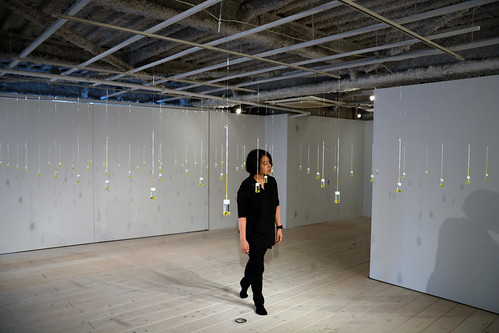
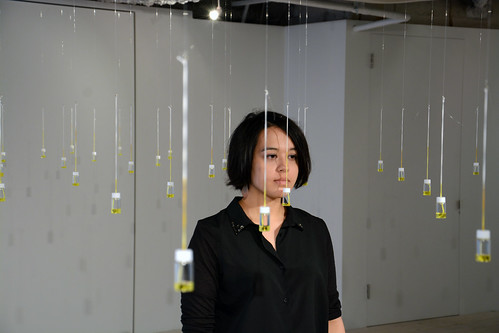
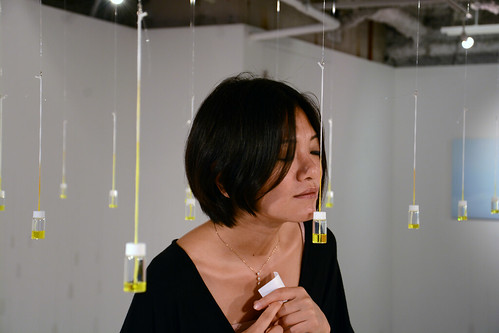
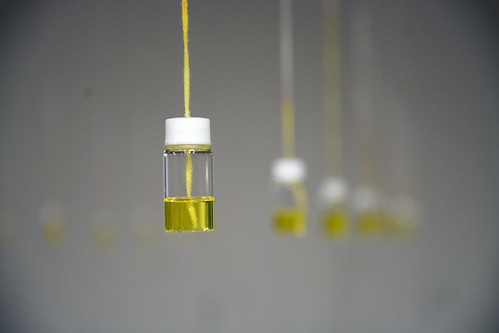
This installation features nine seemingly identical bottles. Six of them contain different synthesized pheromones and three of them contain only a dissolvent. The strings that suspend the bottles descend in the bottles, absorb the scents and disperse them into the air. Moving autonomously like a mobile, the bottles simulate the flow of people in an urban setting. This work examines olfactory perception in a context where the movements of scents and individuals constantly shift in relation to one another.

The concept critically reflects on society’s fascination with pheromones. In nature, pheromones are vital messengers for survival. For example, truffles contain androstenol, a pheromone found in male pig saliva. When a female pig detects it, she assumes a mating posture, which humans use as a clue to locate truffles underground. Androstenol is also present in human sweat and urine, but it does not evoke the same behavioral response in humans. The vomeronasal organ, responsible for perceiving pheromones, has atrophied in humans, rendering these substances ineffective in the way they function for animals.

Even so, the belief in pheromones persists. In this installation, observe your reaction as a bottle passes by. Do you sense anything? Where is the line between pheromone and scent? The work explores boundaries: what can be smelled and what cannot, what is felt and what is not, what attracts or repels.

[About the Series]

Olfactory Labyrinth is a series that explores themes of olfaction and movement. This version builds upon ver. 4, while ver. 7 shares a similar structure but focuses on the facets of scents carried by mountain air.

[Medium]

Bamboo skewers, glass bottles, strings, silk threads, synthetic fragrance materials (aromatic substances presumed to be pheromones), and solvents.

[Exhibited Pheromones]

All pheromones displayed are perfume materials sourced from PerfumersWorld. They are not animal-derived but are artificially synthesized, and provided at lower concentrations than recommended to ensure safety.

A: α-Androstenol (Sample Bottle 1)

B: β-Androstenol

C: Estratetraenol (Sample Bottle 2)

D: Copulins

E: Androstenone (Sample Bottle 3)

F: Androsterone

Smell them individually (focused), or all together (zoomed out) on the test strips. It was revealed during the exhibition that younger individuals were more likely to detect the scents, while many people over the age of 30 reported being unable to smell them easily. Therefore, the experience of “not being able to smell” is also an integral part of this work.
OLFACTORY LABYRINTH VER.2

space installation (2015)
DATE: Premier March 24, 2015
VENUE: Museum Villa Rot, Germany
CONTEXT: Exhibition “There is something in the air”
CURATOR: Caro Verbeek
SUPPORT: Jean Bouis Perfumery Co., Ltd.

[Experience]

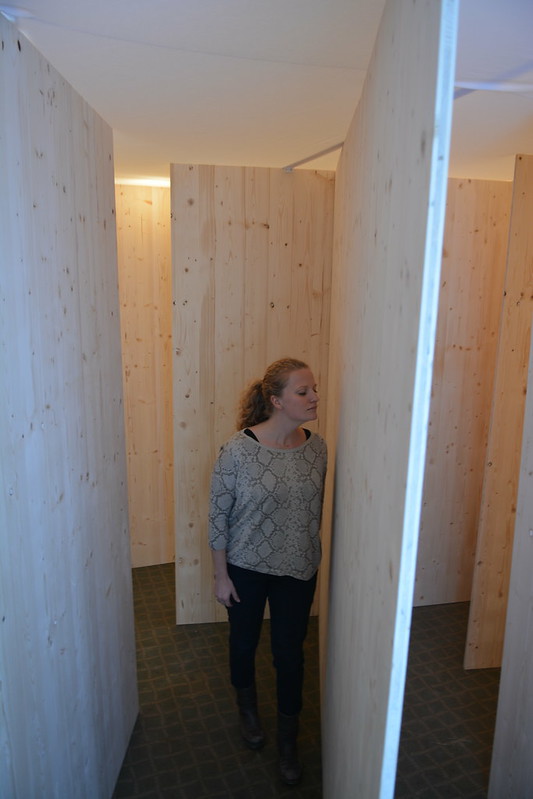
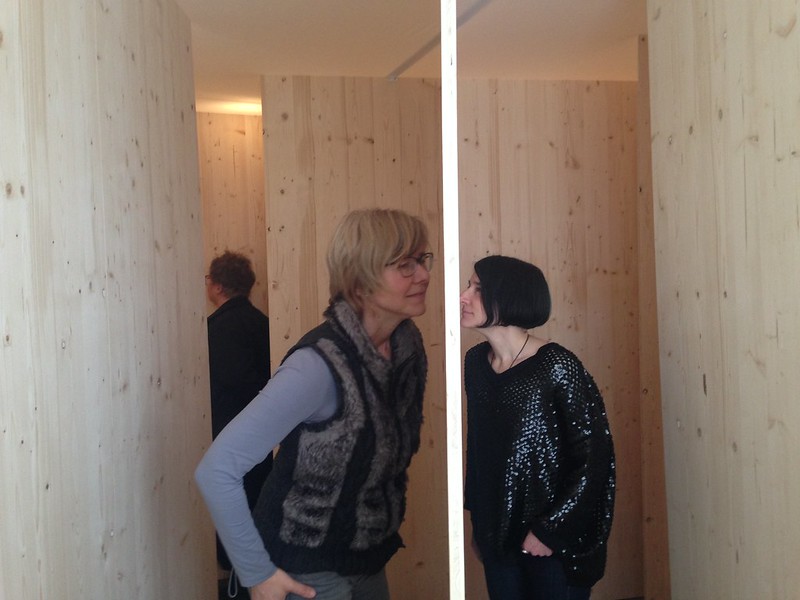
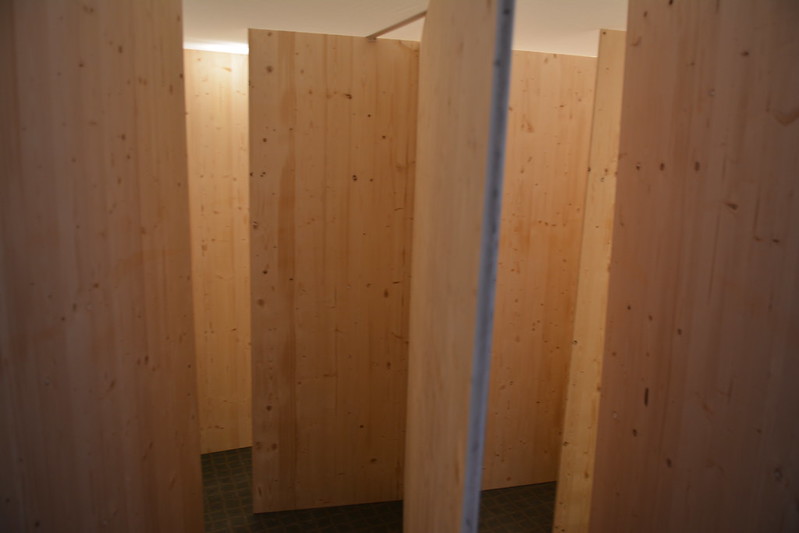
“The walls are inpregnated with different woody smells: Cedarwood, Olibanum, Patchouli, and Labdanum. Find the exit by folling one scent that starts from the entrance.”

IMG_4883

DSC_2343

DSC_2344


DSC_2359

space_design_0004_with_scents


DATE: February 14, 2019 (premier) – February 14, 2020
VENUE: Musee de la Main, Lausanne, Switzerland
CONTEXT: Exhibition “QUEL FLAIR!”
CURATOR: Musee de la Main
SUPPORT: Firmenich (Geneva)

https://youtu.be/izy25xQPPrw


https://youtu.be/BiPSGJFmp1o

OLFACTORY LABYRINTH VER.1

space installation (2013)
 
DATE: September 11, 2013 (wed) – September 29, 2013 (sun)
VENUE: ATSUKOBAROUGH – arts drinks talk
CONTEXT: Sharing Vibes Exhibition
CURATOR: Yukiko SHIKATA
SUPPORT: Yamamoto Perfumery Co., Ltd.

■Introduction - move, smell, and sense –

This looks like an installation with bottles hanging from the ceiling in a grid. It is actually a space designed for olfactory exploration.

Each bottle contains fragrant oil. The candle rope by which it hangs from the ceiling gradually absorbs the oil and spreads the scent around the space. The oil is just strong enough to be smelled from a 20-cm distance.

Each grid is about 40 to 50 cm, just wide enough for a person to walk through while smelling.

Three different fragrant oils are used, and they are placed in such way that a person can trace a smell from bottle to bottle. They are placed in clusters or in lines, like a Reversi game. It’s a small, playful “olfactory labyrinth” that also tests your sense of smell.

The construction is flexible, allowing the level of complexity to be adjusted to any target group during exhibition. In this way, it is a platform for experimentation and there is no final, fixed form.

■Focus

The main focus is the olfactory experience rather than the scent itself. Often in olfactory installations or exhibitions, the focus is on guessing a smell or evoking memories and feelings. I think, though, that smell is, in itself, neutral. It’s the audience who attribute meanings such as “I dislike this smell” or “This is the smell I knew from my grandma’s house” after processing olfactory information in their brains. My memories are different from yours, so how can I assume that what is a “sweet smell” to me will have the same meaning to you?

Such meanings to smells are given from personal experiences and histories. This is why I chose not to give meanings to smells in this project. I rather want to be open to surprising olfactory experiences that we normally wouldn’t encounter in daily life. Omni-directional olfactory experience has been forgotten in our modern life, so reviving it is especially interesting. You can become convinced that human beings, much like dogs, have the ability to sniff around and navigate themselves using their sense of smell.

In our society it’s not considered good manners to talk about smell, but it’s recommended to do so here!

■Background

In recent years my key words have been “movement” and “olfactory experience”. I’ve been researching omni-directional olfactory experiences within a certain space. The sensations created by actively walking around and finding smells are very different from just passively receiving smells. I think I’m one of the few artists researching this discipline.

I’ve wanted to make an “olfactory labyrinth” for years. I’ve thought about a big construction in an open space, or an interactive installation with sensors. But I first wanted to experiment at low cost, resulting in this first prototype for future development.

I selected the fragrant oils while wondering how to make a finer resolution of smells within a certain space. Without my sponsor Yamamoto Perfumery Co., Ltd. such experimentation would never have been possible.

I tried to exclude visual and audible aspects in this work as much as possible. I let the work explain itself rather than doing so in words. Instead smells and space communicate with your physical sensations, allowing you to project images and play sounds in the mind. I believe that smell possesses such power.

DSC_0151_adjusted

DSC_0159_adjusted

DSC_0178_adjusted

DSC_0298

[Cutatorial Note]

On “Sharing Vibes: As Part of Resonating Place”

“Sharing Vibes” is presented as a place where we may discover the world anew by starting to recall the diverse invisible and immaterial information―odors, water veins, flows, etc.―that we usually cannot sense, or fail to notice.

It is in this space that Fuyuki Yamakawa, Maki Ueda and Kenshu Shintsubo will attempt to originate a resonance using, sounds, odors, photography and other media. All three avoid confining their works into distinct media or meanings, and instead regard them as potential information so to prompt us to open up our perceptions and thinking.

Yamakawa showcases a new work that makes underground water flows audible and visible. The research he carried out to create this work will also be presented in the form of a portable map that visitors can take with them in order to feel the water veins in Shibuya. Ueda’s “labyrinth” composed of multiple odors is a place where each person gives active attention to the sense of smell. Shintsubo’s works vividly capture the phases of water that circulates the world through the atmosphere and trees.

The mutual interaction among the works,the mutual influence between those who share the space, and the new vibrations that are born through the multiple resonances between the space, the works and the people… A place each of us participate as a part of the exhibition, of the space and of the world. “Sharing Vibes” does not end.  (Yukiko SHIKATA, Curator)

NEXT—> WORKSHOP