AESTHETIC OF THE WORK OF MAKI UEDA, written in 2019
1. INTRODUCTION
The most important thing we can do as olfactory artists is to provide new olfactory experiences for our audiences.
The sense of smell has been mainly used for survival up until recently; for detecting fire, enemies in the dark, and the decay of food. Fragrance, especially with medicinal and anti-bacterial properties, has also been used for survival. The use for genital acts could also be categorized as an act for survival.
In recent times, however, we have more margin to utilize the sense of smell for pure pleasure. When perfume first appeared a few hundred years ago, it became possible to use scent in a creative way, or express a message, or to carry out a manifesto. The history of olfactory art is even shorter. Even if it is defined as art expression using smell and fragrance in a broad sense, its history may be mere 100 years or so.
Based on this, I believe that olfactory artists should hand searching the world of smell and fragrance over to the perfumery for the moment, and focus on the unveiled olfactive experiences.
I have been active in the field of olfactory art since 2005. Back then “olfactory art” was not a frequently used term, so I was calling myself a “scent artist” or “smell artist”. However, when I noticed a few years later that I was rather more interested in the sense itself rather than the smell, I decided to call myself an “olfactory artist”, even though it was not frequently used. My background is media art, and in the media art scene the term “haptic art” was commonly used, so I got inspiration from there. Other olfactory artists known to this day seem to have started using the same term then.
There are plenty of artists in the olfactory art scene nowadays. However the aesthetics of olfactory art are still unestablished. I will describe my standing point and aesthetics in this essay.
2. MY STANDING POINT
2-1. OLFACTORY ART IS (SHOULD DEVELOP) LIKE MUSIC
When I made a work with the scent of the city of Singapore when there were still fewer olfactory artists, I was told that it was an imitation of other work. This presented an interesting question: what makes olfactory art original? The other work’s concept certainly was about the scents of a city somewhere else, but the method of approach and realization was completely different.
Scent scape (scent of a city) is a theme which tends to be chosen at the time of the start-up of many olfactory artists. When paying attention to the sense of smell, the city smells a little different, so it becomes an inspiration. Such work and workshops can be found everywhere nowadays. Likewise, other themes that are likely to be selected are “body odor and identity” and “smell of death”; scents related to familiar thing or person, and something sensational.
Then, I thought, from what point does something become imitation rather than an original work of art? If I were the first one to make the scent scape in the world, may I think no one else is supposed to make such work no matter how he/she thinks of it, because it is my concept? This is close to the idea of conceptual art.
Trough this experience, I thought I want olfactory art to be like music. For example, a composer inspired by the River Danube creates music on the theme of the Danube. That does not mean that no one else should make music on the Danube. The Danube is a theme to the last, and although it is an inspiration, it is not a concept.
Thus the concept “smell of the city” should not be the center of the originality in the scent scape. Let us make a concept that is one level higher, on a meta-level —- that is how I am teaching students. In the olfactory art, a work where you only let audience feel the scent might also be valid, however we still have to explain the concept. I want the artists to explain what is different from other works dealing with similar scents, and where the originality of the work is.
It is even more ideal if there is database and appropriate criticism on top of it. For example, there are categories such as classical and pop in olfactory art, and it does not mean to be classified as classical just because the work’s theme is the Danube. Consequently, that would prevent the situation where only a sensational work tends to achieve interests. This is how I would like olfactory art to develop.
2-2. SCENT IS NEUTRAL
There is nothing more subjective than smelling. For example, if I thought about making a work on body odor, I would first make “fragrance of body smell”, However, there is a high chance that the smell of body odour to me is different from what it is to you. Furthermore, your opinion about the scent might be different from mine. You might find it a bad odour whilst I find it nice. You might even find it unbearable to smell.
To me it seems that scent is too unreliable to present a concept, because scent is, in its nature, neutral.
Olfactory artists often entrusts a concept of a work to the scent. However when considering that scent is neutral, doesn’t it matter what scent you use?
For that reason, I am challenging creating works whose concept does not change even if I change the scents. Since it does not require a specific scent, there is no need to rely on fragrance companies or perfumers, so it is also low cost.
3. MY MAIN CONCEPTS
To this day, I have presented various works whilst meeting the conditions and expectations of exhibitions from time to time. These revolve around various concepts, which are also my research themes.

3-1. EXTRACTION & REPRESENTATION
Early works (2005-2008) of mine explore this theme in particular. I was given some clues from various cooking methods and achieved some unique distillation skills. Therefore, it looks like a magician who can extract anything, but that was not my intention.
Being able to extract anything means that you can make the aroma portable, or you can present it again beyond time. Every odour has its time axis and spatial axis. By shifting it and choosing an unique context, an interesting olfactory experience arises.
EXAMPLES:
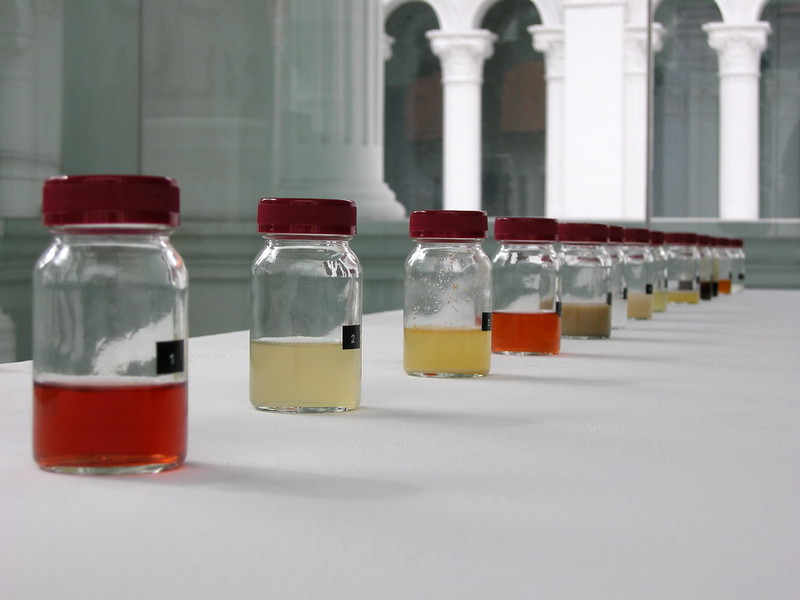
(1) The work whose spatial axis is shifted: AROMASCAPE OF SINGAPORE I studied the smell of Singapore with students, extracted it at the workshop, mapped it on a reduced map and displayed it.

(2) The work whose time axis is shifted: THE JUICE OF WAR – HIROSHIMA & NAGASAKI –
I simulated the smell after the atomic bombs were dropped in Hiroshima and Nagasaki in 1945, and revived it to the present time with the original installation.

3-2. DE-CONSTRUCTION & RE-CONSTRUCTION
Odour has the physical characteristic of mixing in space with other odour. When diffusing scent A and scent B close to each other, the fragrance mix in the room and it becomes impossible to distinguish one from each other unless you get closer. Keeping this characteristic in mind, by putting different aromas at different spots, you can zoom-in and zoom-out to the scents by freely moving around. You can smell individual scents by zooming in (DE-CONSTRUCTION), and you can smell the total fragrance in the space by zooming out (RE-CONSTRUCTION).
This is a somewhat educational work group that becomes a clue to understand scents more physically with full use of olfaction.
EXAMPLES:
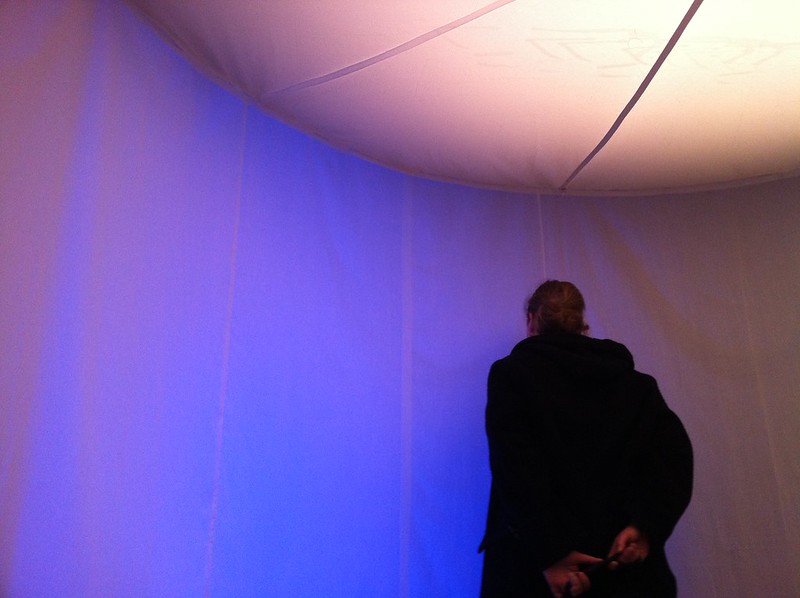
(1) OLFACTOSCAPE – DECONSTRUCTION OF CHANEL NO. 5 – The inner wall of a cylindrical space is divided into ten parts and impregnated with a single fragrance component. The component used here is one of the top ten components of Chanel No. 5. When you stand in the middle, you can smell the mixed, total scent: the Chanel No. 5.
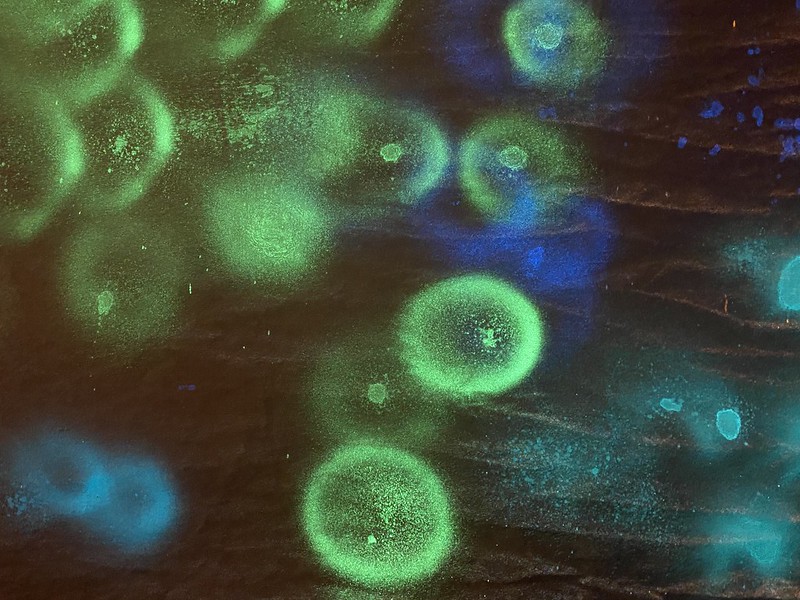
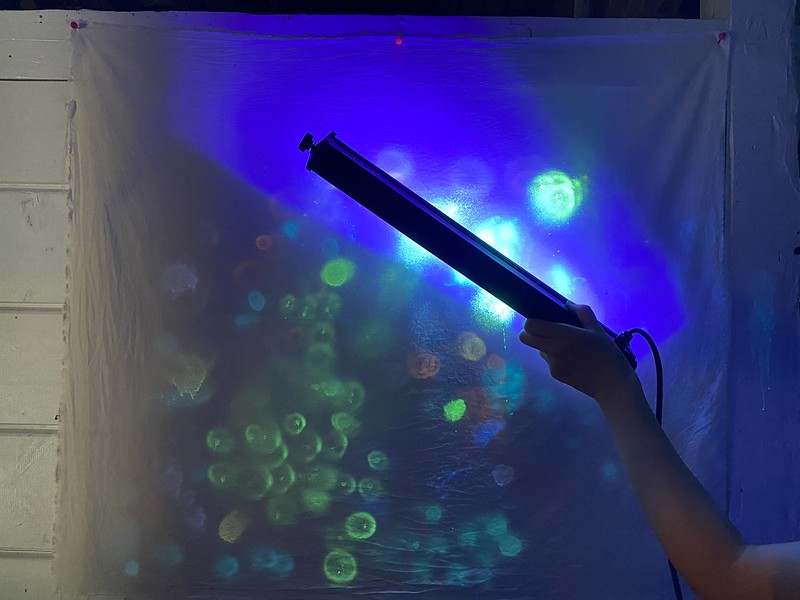
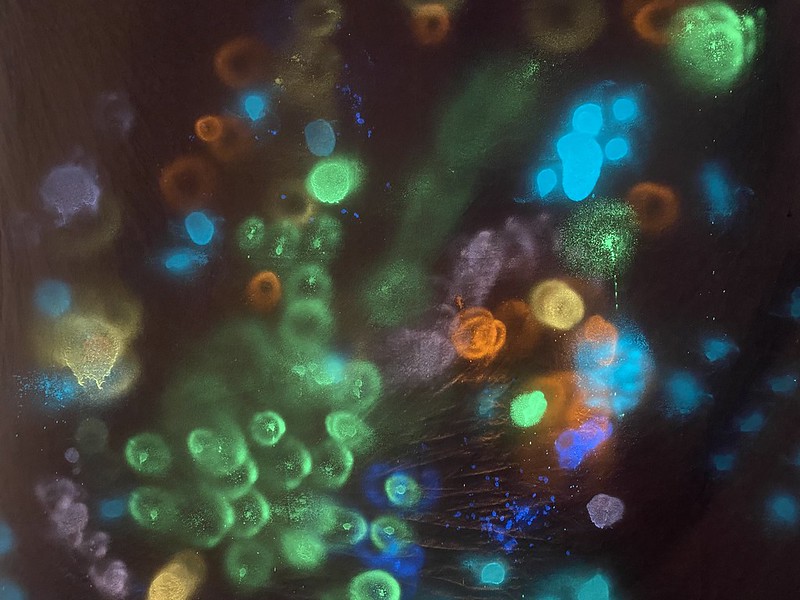
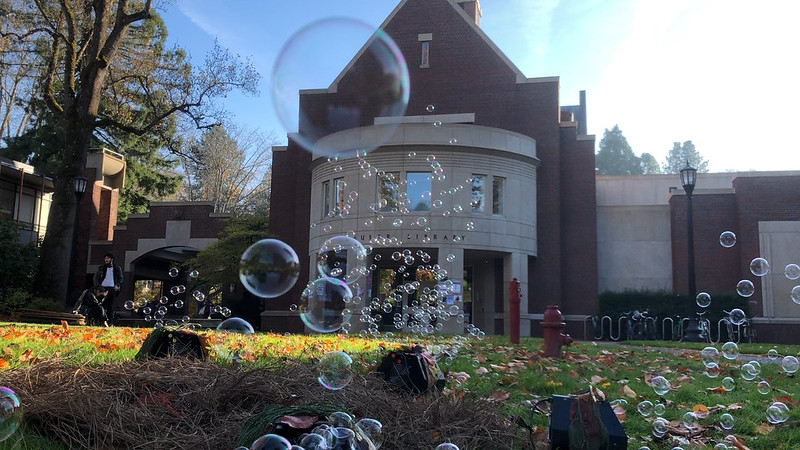
(2) TANGIBLE SCENTS – COMPOSITION OF ROSE IN THE AIR – Soap bubble liquid is impregnated with one of the top five components of rose. Each one is blown (diffused) separately and forms a field of the rose scent. You can not only poke the bubbles and smell the individual scent, but also just stand and immerse yourself in the total scent: the scent of rose.
3-3. SCENT-DRIVEN COMMUNICATION
What is smell for us? In the world of flora and fauna, smell is communication signal (pheromones) for reproduction and survival. However, in the human world, there is no such pheromone in that sense. And as mentioned earlier, due to the changes happening over time, the role of olfaction is changing.
It is not an exaggeration to say that in the world of Kodo, the play that shares the world of imagination among players while enjoying metaphors with smells (for example, the dry aspect of a fragrant wood becomes a metaphor for dry sky in winter), smell carries information.
Such a sophisticated sense of smell only belongs to humans. Now that the role of olfaction is changing over time, would it be possible for us to explore this possibility more?
EXAMPLES:
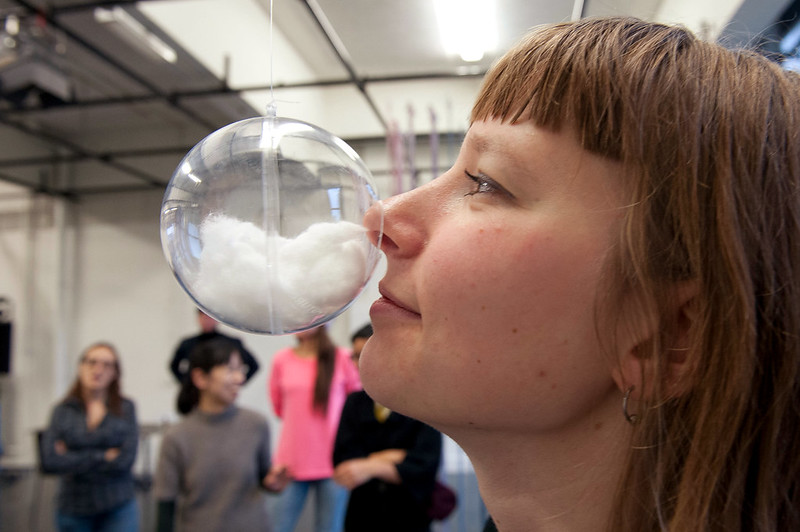
(1) Smell is used as Morse code: OLFACTORY GAMES For over ten years, I gave a course of olfactory art at the Royal Academy of Arts in The Netherlands, where students made games for olfaction. As an example, I introduced them to a Olfactory Memory Game and Olfactory Duck Duck Goose. The students’ imagination knows no boundaries: more than 70 games were being developed in the course in the past.
(2) Smell carries metaphor: KYOTO LOVE STORY In the world of the Tale of Genji (about 1200 AC), the encounter between men and women was over bamboo blinds, and it was not allowed to speak directly. Communication was made through a messenger, poetry, or fragrances. Kyoto Love Story is a blind date event conforming to this communication protocol.
It was an experiment of odor communication in the high cultural context. For example, there was a man who gave a yuzu, a metaphor of the winter solstice, to a woman. Here, the aroma of yuzu is a medium that carries compassions such as: “I hope you get warm with yuzu-bath – they say you will not catch a cold when taking yuzu-bath at the winter solstice.” (Please refer to Yoko Iwasaki’s paper about this work)

3-4. SCENT-DRIVEN MOVEMENT
Some of my works exclude visual elements and let visitors move around space by relying only on odour. Like a dog, sniffing to the right and to the left, you feel the difference in concentration and you can find the source of the smell. It is also an experiment of omnidirectional smelling.
EXAMPLES:
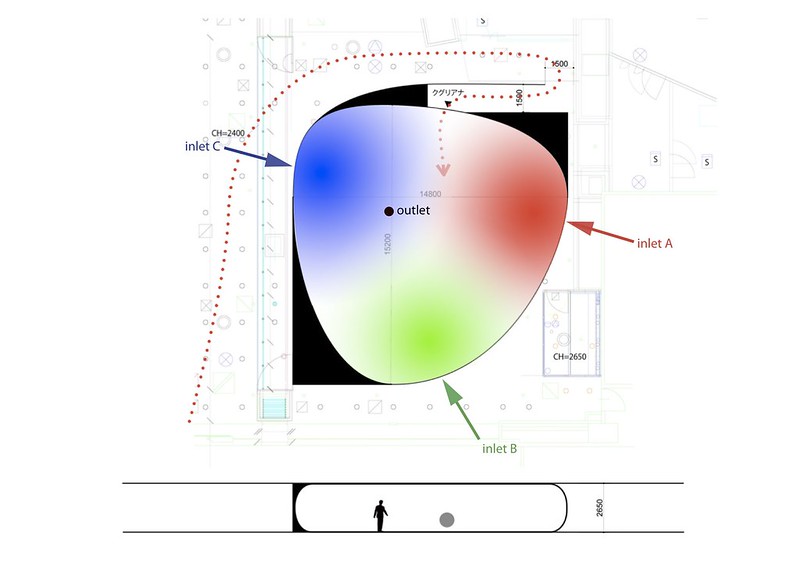
(1) INVISIBLE WHITE A piece where you walk around by relying only on odor in a blank space. The space has no corners, no shadows, and therefore, you have no sense of distance and orientation. Three odors flowing into the space with its own timing results in the permanent change of spatial scent. It is like invisible RGB gradation. As you proceed, you smell the different scents.

(2) OLFACTORY LABYRINTH VER.2 A real maze where you always follow the same smell from the entrance to reach the exit. You are required to distinguish four scents.
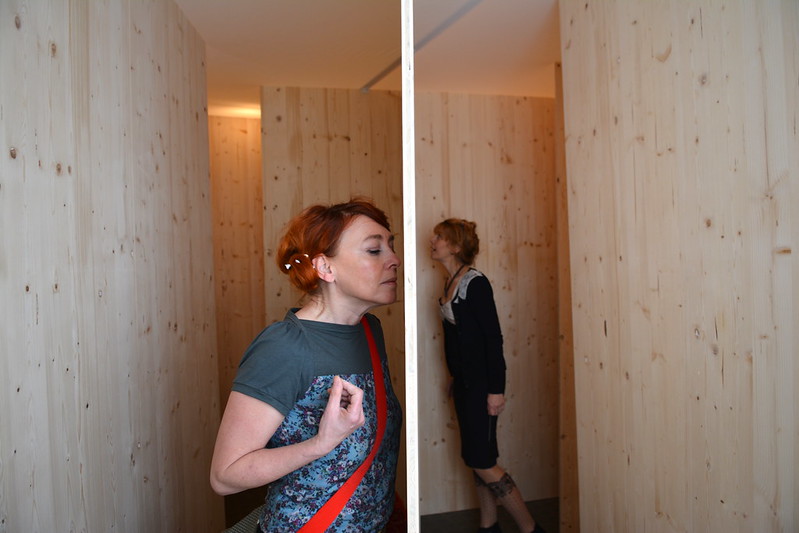
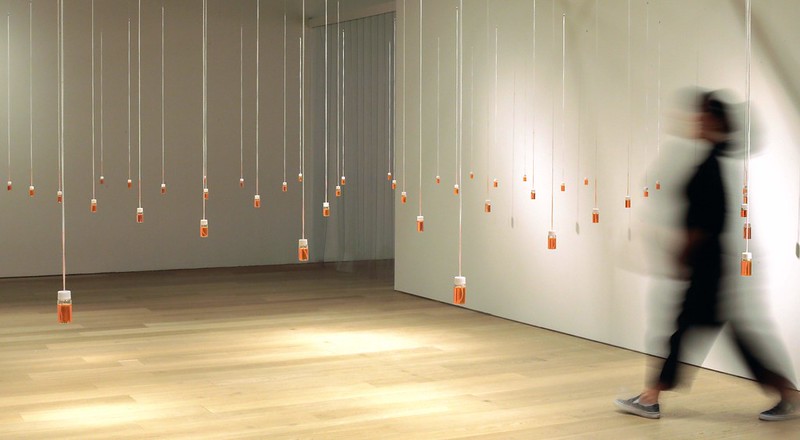
(3) OLFACTORY LABYRINTH VER.4 A maze with a game-like element where you are supposed to find three invisible cherry-blossoms. Bottles are hung in a matrix of 9 × 9. As you get close to the invisible cherry blossom, you smell stronger. Weber-Fechner’s law (logarithm) is applied to the relation between stimulation and concentration of odour.
4. FUTURE PERSPECTIVES
An artist is, I think, a person who keeps asking questions such as “What is humanity?” and “What is life?” through works with the power of aesthetic. I might put the question in other words and say: ”What possibilities are hidden in the human sense of smell?”
If I use an analogy of an academic method, my standing point as an artist might be a “hypothesis”, and the final work might be the “answer” or “conclusion”. And although the order is reversed, the audience itself may experience it as “proof” or “witness”. I form conclusions while imagining how the audience would interact with the work.
Recently, I have started to create works to search poetically between the olfactory and tactile / visual sense, like TANGIBLE SCENTS. I believe that with many more experiments, I pursue the possibility of human olfaction, and let it evolve even further.