Here are some extracts from the past interviews.
October 2018, in Hong Kong:
> 1/ Have you been to HongKong?
Yes, the first time was about 20 years ago. The second time was about 2 years ago.
> 2/ Do you have any impressions or ideas about the smell of Hong Kong?
Yes and no. I smell something similar to the whole Chinise cultural area like Singapore and Shanghai, so they might not be specific to HK much. Also I smell the sewage everywhere. This is often the case in the big cities. Olfaction is very personal and I’m just a visitor. You might know it better if you live in HK.
> 3/ As we know, you have been involved some art project which related to City, Can the fragrance be used as an angle to understand and observe a city?
Yes and no. It’s too easy to generalize that the scent “A” is something specific to HK. It might be the case in the other cities too. We live in the best time of mobilization ever. It makes us harder to find the “original” and “characteristic” scents of the cities. That’s why people like making questions such as “What’s our unique scents in this city?” I guess. In my art projects I’m showing this dilemma and contradictions.
October 2014, Interviewer: Camilla Maurer
> What meaning does smell have for you?
It’s simply a medium for me.
> Can you tell me about a situation where scent was important for you. (Childhood)
I was composing a pot-poulli as a hobby. It was trendy in the herb scene in Japan. That was my first introduction to composition.
> Do you experience visual dominance?
Yes. For smelling the visual over-rules everything too.
> From which discipline are you coming?
Informatica and media study.
> Was there a situation in your life, when you decided to use the sense of smell as a medium for your art?
A couple of years after I gave a birth, I started olfactory art.
> How do you handle the problem of not having precise words with which to discuss smell or scent? Or do you think Nederlande or Japan are more precise words for smell? Explain in detail.
I don’t find that smell is special in that sense. To discuss about sound or light, it’s also difficult to say if we have the precise words for them. The sensation is very personal.
> Which was your first olfactory smell-work you realized? Was war deine erste Geruchsarbeit die du realisiert hast?
Menu for the Nose.
> Does your work have a common main theme? I meen you starded with cultural themes, cities, victims , scent of lands, japanese woman, labyrinth…
> No, every work is different.
> Do you think that knowing about smell helps us know more about the world? Is knowledge power in your definition?
Certainly. Your perspective becomes totally different if you start exploring the world by the olfactory sense.
> Hypothesis: Do you have an Idea why in the 21. Century Artists decide to work with smell?
I think many artists also worked with smell in the 20th century, like The Futurist and Duchamp. Not a very new thing for the artists.
> Which possibilities and constraints do you see in working with smell?
We cannot preserve the work like a sculpture. Therefore we cannot “sell” the work. That keeps the art-form alive and vibrant.
> If you could invent a system to make categories for “good” and “bad” smell, what would it look like? What meaning does smell have in belgien culture, particularly in your City?
I think again it’s very personal… but if I would, “physically accepted” or “physically not accepted” would be the category. The latter ones would cause physical reactions as vomiting.
> Do you think sympathy or antipathy of smell is set at birth, or is it learned?
Learned.
> Important:
What is possible with olfactory art as compared to visual art?
Time and space based experiences. The experience of the moment is never the same.
> Hypothesis: Why do you think many people trust the visual sense more than their nose?
The visual sense is good at creating comfort by offering information on distance.
On the contrary, the olfactory sense creates discomfort because the receiver is forced to take the chemical substance in the body (nostril).
> If you have to name a similar discipline in art, would you say olfactory art is more like music or more like performance?
Olfactory art is very much like music. Music is time-based art. And olfactory art has space aspect to it.
> Do you see it critical that many artists need the help, knowledge and interpretation of professional perfumers or chemists ? If they want to realize something with smell?
I don’t necessarily think so but I personally do not want to limit myself in exploration in the medium. If you ask someone to help, you’re very limited.
> Do you work with IFF or any others company or “only” with the material an the extracts?
Sometimes Steven Pearce at Omega Ingredients helps me by supplying materials.
> You used kodo for some academic works, why?
It is a good example of “olfactory game”.
> What is the main difference you think, if you create a perfum or a scent for an exibition? Or do you think there is one? Because you also make perfumes (7smell, scnet of holland, ..)
The perfumes I made for the exhibitions are not to be worn as perfume, but to be smelled.
2008
1- How you define your practice/research?
I’m researching on the sense of smell, and the smell / odor / scent. My challenge is to use them as a medium in art. The sense of smell is one of the most instinctive sense in the body, and has the instant connection to our imaginations and memories. I got interested in this field since I was working before with the digital media researching on the remote/global awareness. The smell / odor / scent travels beyond time and space, directly contacting one’s image and memory. These characters of smell as a medium is something totally different from that of the digital media.
2- Why to experiment in Architecture?
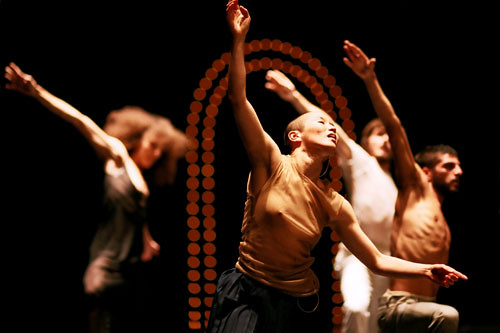
The scent as a medium naturally has a spacial character like the architecture has. I have once worked on perfuming the space for the dance performance. From monitoring how the audience react, I am convinced that a big part of the human behavior is actually driven unconsciously by the scent. In that extent I see the common factors with the architecture. So the experimentation of the audience’s behavior in the scented space/architecture would be very interesting.
3- Which perception do you have of the use of creativity in your practice/research?
If I can invent a new way of using a medium that communicates well with the audience, or if I can create a totally original medium on, I would evaluate my work ‘creative’.
4- How the studio is an important element for the final achievement?
The scent is something super local – the molecule evaporates quickly and fades away before saving it in the harddisc. So working in the studio somewhere means, for me, focusing on the local scent. For example, If I would work in Portugal, I would work with some Portugal-original scent. And its result would become something totally not produceable anywhere else.
5- What are your current topics of interest in these fields?
Scenting / Perfuming the space, and experiment with the human behavior. I’d like to create such a space where the audience explore with their nose (only!).