A Participatory Multispecies Environment of Chemical Signals (Aerosculpture ver.2)
“Smell is a long-distance sense, a way of stretching time and finding out in advance what lies ahead.”
— Lyall Watson
Olfactory Biome is a site-responsive environmental installation that explores an ecosystem organised through smell rather than vision. Set within a tropical greenhouse, it invites visitors to experience an invisible biome shaped by chemical signals: scents that attract, repel, or confuse other organisms.
The experience evokes walking through a forest at night. The space is kept in near-total darkness, illuminated only by moonlight filtering through the greenhouse roof. As vision becomes unreliable, perception is reorganised. Awareness expands in every direction, and the sense of smell becomes increasingly acute. The soles of the feet and ears begin to function almost like eyes. Small blinking lights reminiscent of fireflies provide minimal orientation.
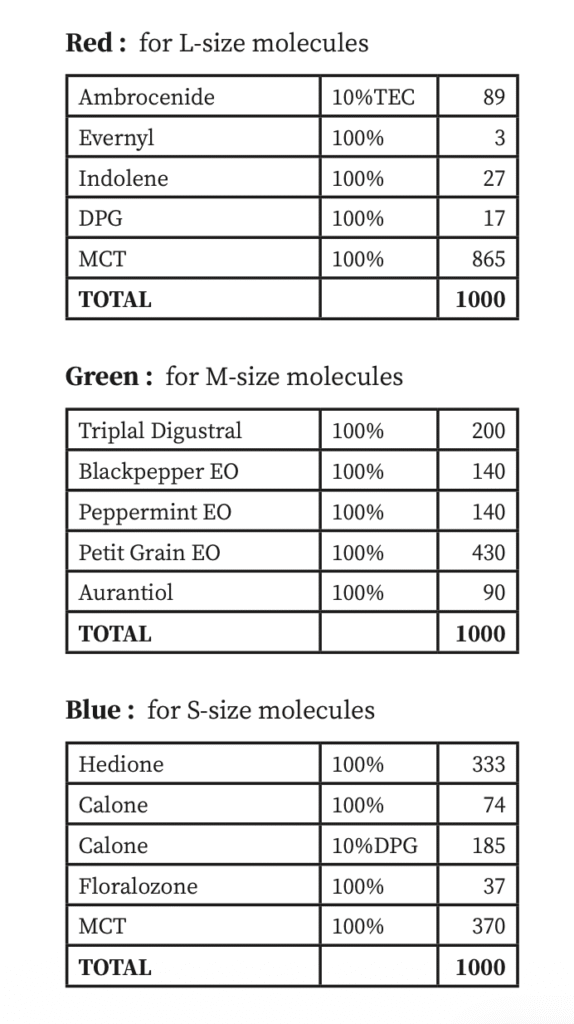
Before entering the space, participants choose the role of a moth, bat, or human, composing fragrances that attract or repel. They carry them on their bodies, becoming mobile sources of chemical signals. Scents dispersed throughout the space by particles such as mist and fog, sometimes visible and sometimes imperceptible, lure and confuse participants.
In natural ecosystems, organisms constantly exchange chemical signals. Flowers emit volatile compounds to attract pollinators; animals such as moths and bats respond to pheromones and food odours, and plants release warning signals when damaged. These invisible exchanges form an atmospheric layer of ecological communication. This installation invites audiences of all ages to participate actively in such an atmospheric field of chemical signals.
The installation also incorporates a sonic environment designed to enable participants to detect each other’s movements through changes in echoes, recalling the way moths emit ultrasonic clicks to disrupt bat echolocation and avoid predation. Rather than overwhelming visitors with audiovisual spectacle, Olfactory Biome encourages immersion in internal sensory awareness. The work explores olfaction as a means of environmental knowledge, proposing olfactory intelligence as a form of resilience that enables us to perceive and adapt to changing environments.
Exhibition title: Aerosculpture ver. 2 – Olfactory Biome –
Venue: Yumenoshima Tropical Greenhouse Dome
Dates: 30 January–1 February 2026
Exhibition Guide (Google Doc):
https://docs.google.com/document/d/10yL7i4G4LHS-x38ShiQxH6deM1U6XKuIrovRcDTW9xA/edit?usp=sharing
Workshop Guide: