A Bio-Logging System for Smellscape Capture and Playback
What is that dog sniffing so happily? Inspired by this simple question, Dog’s Nose combines environmental sensing and digital media to record and replay a dog’s smellscape, allowing humans to vicariously experience a canine sense of smell.
Dog’s Nose is a multispecies bio-logging system in which a dog carrying a chemical sensor records smellscapes that can later be reconstructed through a digitally controlled olfactory playback system. Air is sampled near the dog’s nose through a small tube and transported to a portable FAIMS device developed by Ricoh. As the dog moves freely through its surroundings, airborne molecular patterns are measured and translated into digital data. The dog’s movement becomes a form of bio-logging in which the animal acts as a multispecies carrier of environmental sensing. While bio-logging technologies are widely used in ecological research to monitor animal behaviour and environmental conditions, Dog’s Nose extends this approach to sensory documentation.
The collected chemical data are mapped to an olfactory and visual playback system that reconstructs recorded smellscapes in another place and time, allowing environments encountered by the dog to be experienced later by human audiences.
The smellscape is also shared through a spatial interface. Simplified scent compositions are printed onto a floor map using microencapsulation technology. Through this tactile interface, visitors of all ages can explore a spatially reconstructed smellscape by touching and smelling different locations on the map.
The project also includes the participatory urban Chiyoko Walk, guided by Chiyoko the dog. Walking with a ‘wild nose’, far more sensitive than that of a human, participants could explore the city through smell, perceiving it as a dynamic field of chemical signals.
The project addresses a gap in contemporary media infrastructures: while visual and acoustic environments can be recorded and reproduced, smell, despite being a fundamental component of environmental perception, remains largely absent from media technologies. The project proposes a new way of recording, sharing, and experiencing olfactory environments as environmental knowledge.
Recording Sessions (2 hours each)
15 October 2025: Shibuya–Meiji-dori
15 December 2025: Harajuku
16 December 2025: Yoyogi Park
23 March 2026: Ogikubo
Chiyoko Walk – Multicam Archives (Full)
Exhibition
13 February – 1 March 2026
Civic Creative Base Tokyo (CCBT)
Time-Based Interface
Turn the trackball to replay the dog’s walk through time.
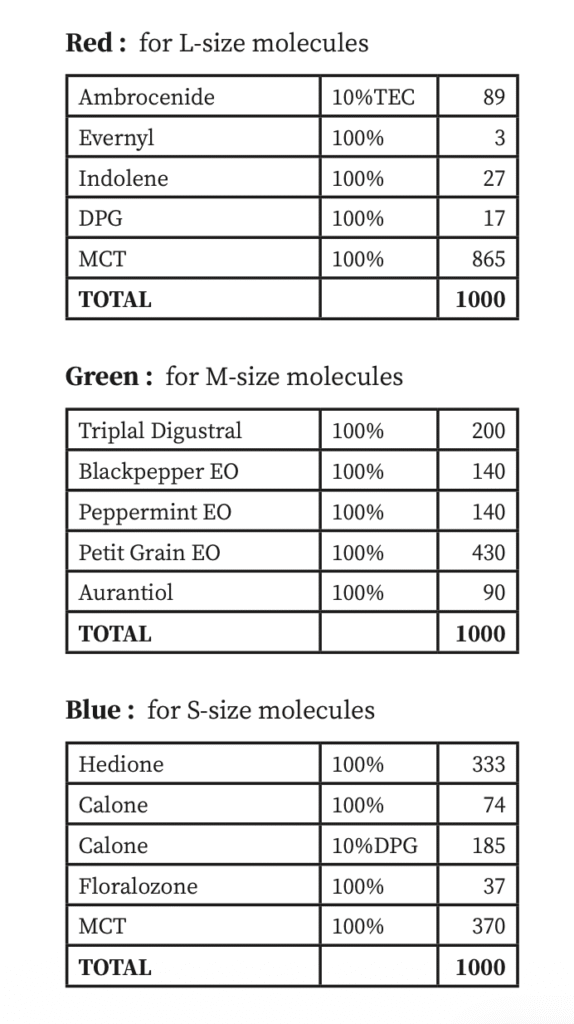
From six hours of Chiyoko Walk recordings through Shibuya and Harajuku, seven moments were selected in which significant changes in air quality closely corresponded with Chiyoko’s behaviour. Airborne molecules were broadly classified into L/M/S according to molecular size, then reconstructed using fragrance molecules with similar characteristics.
FAIMS functions as a scanner of the air, detecting both odours perceptible to humans and those beyond what human smell. Dogs, meanwhile, possess an olfactory sensitivity many times greater than our own. By combining FAIMS with the dog’s extraordinary sense of smell, the system offers a simulated experience of the otherwise inaccessible olfactory layers of the city.
To recreate the recorded smellscapes interactively, scent playback is digitally controlled according to olfactory characteristics, incorporating principles such as the Weber–Fechner law and time-derivative processing.
Equipment: Computer, trackball, monitor, Aromashooter 2 (Aromajoin)
Space-Based Interface
Using microencapsulation technology commonly employed in scented printing and fabric softeners, odours were embedded into a miniature map. Visitors followed the scents like a dog, physically exploring the map.
To avoid affecting the office environment, the scents were detectable only within a range of 10 cm. Three transparent ‘primary odours’ were created and applied using an analogy with colour mixing; for example, purple areas combined the equivalents of Red and Blue.
Microencapsulation: Japan Capsule Products Co., Ltd.
Odour Abstraction Algorithm
For reconstruction, the data were processed using a bespoke algorithm that accounts for human olfactory adaptation as well as the exhibition environment, duration, and scale. Unlike vision, which reproduces images using the primary colours Red/Green/Blue, olfaction has no established equivalent of primary sensory components. The project therefore proposes an analogous model based on the structure of colour, assuming that smell, too, may consist of three hypothetical primary odours. Data representing larger molecules, such as indole, are translated into fragrance materials with comparable molecular size and olfactory character, such as Indolene.
The next formulations are used to reconstruct the smellscape in both the Time-Based and the Space-Based Interface.
Harajuku + Yoyogi Park

Chiyoko Walk Archive
Exhibited at Archive Exhibition (approx. 10 min.)
Report
Please refer to:
Report from Katsuya Ujimoto (Ricoh)