Olfactory Biome

A Participatory Multispecies Environment of Chemical Signals (Aerosculpture ver.2)

“Smell is a long-distance sense, a way of stretching time and finding out in advance what lies ahead.”
— Lyall Watson


Olfactory Biome is a site-responsive environmental installation that explores an ecosystem organised through smell rather than vision. Set within a tropical greenhouse, it invites visitors to experience an invisible biome shaped by chemical signals: scents that attract, repel, or confuse other organisms.

The experience evokes walking through a forest at night. The space is kept in near-total darkness, illuminated only by moonlight filtering through the greenhouse roof. As vision becomes unreliable, perception is reorganised. Awareness expands in every direction, and the sense of smell becomes increasingly acute. The soles of the feet and ears begin to function almost like eyes. Small blinking lights reminiscent of fireflies provide minimal orientation. 

Before entering the space, participants choose the role of a moth, bat, or human, composing fragrances that attract or repel. They carry them on their bodies, becoming mobile sources of chemical signals. Scents dispersed throughout the space by particles such as mist and fog, sometimes visible and sometimes imperceptible, lure and confuse participants.

In natural ecosystems, organisms constantly exchange chemical signals. Flowers emit volatile compounds to attract pollinators; animals such as moths and bats respond to pheromones and food odours, and plants release warning signals when damaged. These invisible exchanges form an atmospheric layer of ecological communication. This installation invites audiences of all ages to participate actively in such an atmospheric field of chemical signals.

The installation also incorporates a sonic environment designed to enable participants to detect each other’s movements through changes in echoes, recalling the way moths emit ultrasonic clicks to disrupt bat echolocation and avoid predation. Rather than overwhelming visitors with audiovisual spectacle, Olfactory Biome encourages immersion in internal sensory awareness. The work explores olfaction as a means of environmental knowledge, proposing olfactory intelligence as a form of resilience that enables us to perceive and adapt to changing environments.

Exhibition title: Aerosculpture ver. 2 – Olfactory Biome –
Venue: Yumenoshima Tropical Greenhouse Dome
Dates: 30 January–1 February 2026

Exhibition Guide (Google Doc):
https://docs.google.com/document/d/10yL7i4G4LHS-x38ShiQxH6deM1U6XKuIrovRcDTW9xA/edit?usp=sharing

Workshop Guide:
Dog’s Nose

A Bio-Logging System for Smellscape Capture and Playback

What is that dog sniffing so happily? Inspired by this simple question, Dog’s Nose combines environmental sensing and digital media to record and replay a dog’s smellscape, allowing humans to vicariously experience a canine sense of smell.

Dog’s Nose is a multispecies bio-logging system in which a dog carrying a chemical sensor records smellscapes that can later be reconstructed through a digitally controlled olfactory playback system. Air is sampled near the dog’s nose through a small tube and transported to a portable FAIMS device developed by Ricoh. As the dog moves freely through its surroundings, airborne molecular patterns are measured and translated into digital data. The dog’s movement becomes a form of bio-logging in which the animal acts as a multispecies carrier of environmental sensing. While bio-logging technologies are widely used in ecological research to monitor animal behaviour and environmental conditions, Dog’s Nose extends this approach to sensory documentation.

The collected chemical data are mapped to an olfactory and visual playback system that reconstructs recorded smellscapes in another place and time, allowing environments encountered by the dog to be experienced later by human audiences.

The smellscape is also shared through a spatial interface. Simplified scent compositions are printed onto a floor map using microencapsulation technology. Through this tactile interface, visitors of all ages can explore a spatially reconstructed smellscape by touching and smelling different locations on the map.

The project also includes the participatory urban Chiyoko Walk, guided by Chiyoko the dog. Walking with a ‘wild nose’, far more sensitive than that of a human, participants could explore the city through smell, perceiving it as a dynamic field of chemical signals.

The project addresses a gap in contemporary media infrastructures: while visual and acoustic environments can be recorded and reproduced, smell, despite being a fundamental component of environmental perception, remains largely absent from media technologies. The project proposes a new way of recording, sharing, and experiencing olfactory environments as environmental knowledge.

Recording Sessions (2 hours each)

15 October 2025: Shibuya–Meiji-dori
15 December 2025: Harajuku
16 December 2025: Yoyogi Park
23 March 2026: Ogikubo

Chiyoko Walk – Multicam Archives (Full)

Exhibition

13 February – 1 March 2026
Civic Creative Base Tokyo (CCBT)

Time-Based Interface

Turn the trackball to replay the dog’s walk through time.

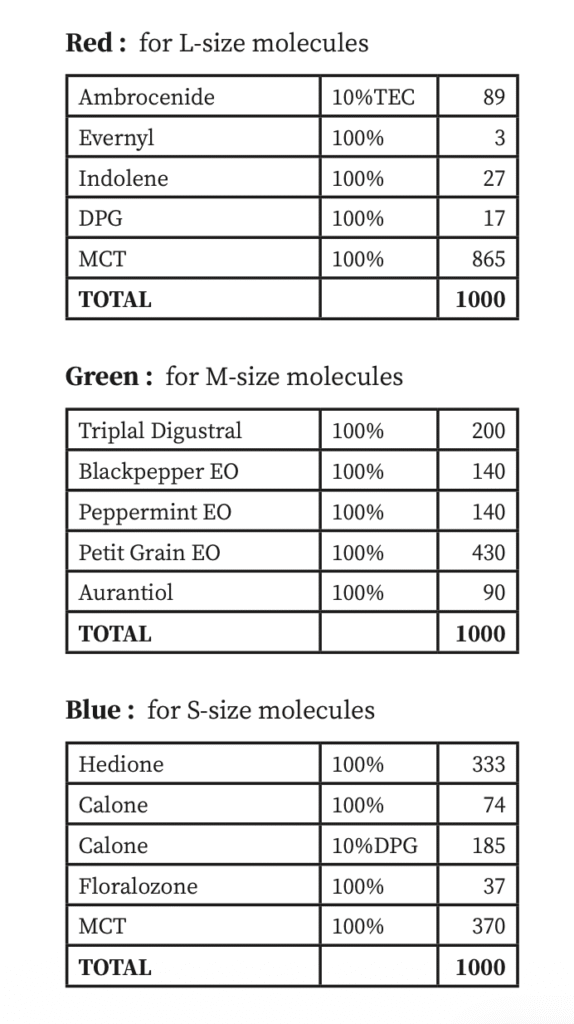
From six hours of Chiyoko Walk recordings through Shibuya and Harajuku, seven moments were selected in which significant changes in air quality closely corresponded with Chiyoko’s behaviour. Airborne molecules were broadly classified into L/M/S according to molecular size, then reconstructed using fragrance molecules with similar characteristics.

FAIMS functions as a scanner of the air, detecting both odours perceptible to humans and those beyond what human smell. Dogs, meanwhile, possess an olfactory sensitivity many times greater than our own. By combining FAIMS with the dog’s extraordinary sense of smell, the system offers a simulated experience of the otherwise inaccessible olfactory layers of the city.

To recreate the recorded smellscapes interactively, scent playback is digitally controlled according to olfactory characteristics, incorporating principles such as the Weber–Fechner law and time-derivative processing.

Equipment: Computer, trackball, monitor, Aromashooter 2 (Aromajoin)

Space-Based Interface

Using microencapsulation technology commonly employed in scented printing and fabric softeners, odours were embedded into a miniature map. Visitors followed the scents like a dog, physically exploring the map.

To avoid affecting the office environment, the scents were detectable only within a range of 10 cm. Three transparent ‘primary odours’ were created and applied using an analogy with colour mixing; for example, purple areas combined the equivalents of Red and Blue. 

Microencapsulation: Japan Capsule Products Co., Ltd.

Odour Abstraction Algorithm

For reconstruction, the data were processed using a bespoke algorithm that accounts for human olfactory adaptation as well as the exhibition environment, duration, and scale. Unlike vision, which reproduces images using the primary colours Red/Green/Blue, olfaction has no established equivalent of primary sensory components. The project therefore proposes an analogous model based on the structure of colour, assuming that smell, too, may consist of three hypothetical primary odours. Data representing larger molecules, such as indole, are translated into fragrance materials with comparable molecular size and olfactory character, such as Indolene. 

The next formulations are used to reconstruct the smellscape in both the Time-Based and the Space-Based Interface.

Harajuku + Yoyogi Park

Chiyoko Walk Archive

Exhibited at Archive Exhibition (approx. 10 min.)

Report

Please refer to:
Report from Katsuya Ujimoto (Ricoh)

Report: FAIMS-Based Olfactory Biologging Measurements in Urban Environments

Katsuya Ujimoto (Ricoh)

Results

Measurements showed that NH3 (ammonia) and the S, M, and L molecular ranges were not uniformly distributed throughout the urban environment but exhibited characteristic spatial distributions and temporal variations depending on location.

In Yoyogi Park, relatively high NH3 signals were observed over a wide area, together with localised hotspots in the M and L molecular ranges. Areas where fallen leaves had accumulated showed increased FAIMS signals, and Chiyoko displayed intensive exploratory behaviour such as running and digging. In open areas of the park, increases in FAIMS signals coincided with Chiyoko’s exploratory behaviour, suggesting that both responded to molecules carried by the wind.

In Harajuku, S and M signals remained relatively stable, whereas L-range signals appeared as brief, intermittent events. Chiyoko occasionally paused near luxury boutiques, variety shops, a capybara café, and narrow intersections surrounded by buildings, but more often she briefly investigated before resuming her walk. These localised events may reflect either moving odour sources or intermittent volatile compounds generated by pedestrian traffic and commercial premises.

In many observations, increases in NH3 preceded increases in the S, M, and L signals, indicating a consistent temporal sequence.

Discussion

Comparison between Yoyogi Park and Harajuku suggests that differences in the spatial structure of odours strongly influenced Chiyoko’s behaviour. In Yoyogi Park, naturally occurring elements may have retained odour molecules and formed stable concentration gradients, encouraging sustained exploratory behaviour and locally elevated FAIMS signals. In Harajuku, odours originating from pedestrian activity and the built environment were more diverse and intermittent, producing unstable odour gradients. Chiyoko therefore often detected odours but ended her investigation at an early stage.

These observations suggest that, for Chiyoko, olfactory meaning depends less on odour intensity than on the structure of the olfactory field. At enclosed intersections, transient increases in FAIMS signals coincided with indecisive exploratory behaviour, suggesting the existence of an olfactory chaotic space created by changing wind direction and turbulence. By contrast, open areas and locations with accumulated leaves produced simultaneous responses from both FAIMS and Chiyoko.

The observations also suggest a two-stage olfactory model. Variations in NH3 concentration may first function as a trigger for detecting unusual environmental conditions. As the source is approached and molecular concentrations increase, patterns within the S, M, and L molecular ranges may then provide qualitative information about the odour. This model is consistent with Chiyoko’s behavioural sequence of detection, running, stopping, digging, or ignoring.

The average NH3 concentration remained below approximately 17 ppb, although local peaks of 100–400 ppb were observed. These results suggest that Chiyoko perceives subtle environmental changes that often remain below the threshold of human perception. Parallel FAIMS measurements made part of this otherwise imperceptible olfactory environment measurable.