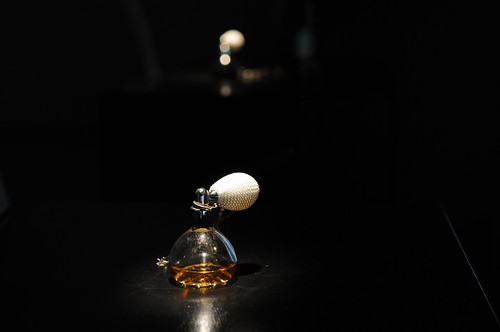
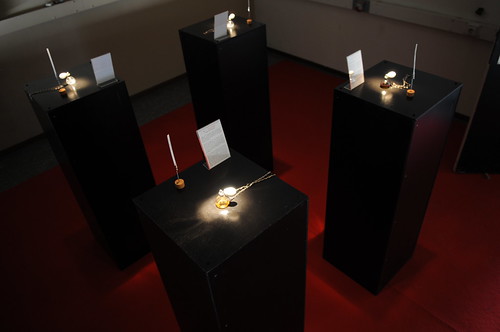
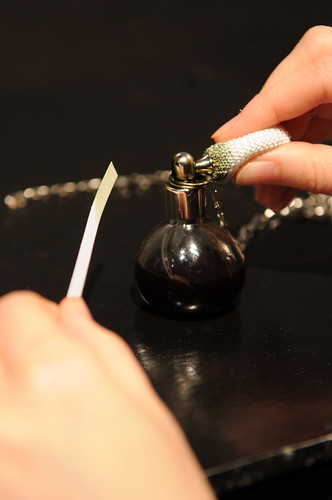
If there ever was: an exhibition of extinct and impossible scents
Rob Blackson
# Syzygium gambleanum, Hopea shingkeng, Ilex gardneriana, and
Santalum fernandezianum
Over the past century, deforestation, climate change, and urban sprawl
have pushed numerous scented and beautiful varieties of wild plants into
extinction. These forces have caused many plants to search for better
places to take root. However, flowering plants with heavy seeds do not
“move” quickly enough to respond to these environmental changes.
Another contributing factor to this problem is the agricultural industry.
Using fertilizers that artificially raise the level of nutrients in the soil
encourages some plant species to move into richer patches of land and,
thus, into competition with other plants for space. Eventually, the less
hardy species are eliminated1.
Syzygium gambleanum, Hopea shingkeng, Ilex gardneriana, and
Santalum fernandezianum are extinct flowering plants. Syzygium
gambleanum, a sharp rose apple of the myrtle family commonly grown in
India, became extinct in 1998 due to habitat loss. Aromatic wood from the
small Hopea shingkeng tree was used to make house posts in India and
as a result was also registered as extinct in 1998. Since 1997, the pungent
herbal smell of Ilex gardneriana holly has vanished. And due to logging,
the smooth scent of Chilean Santalum fernandezianum sandalwood has
been gone since 1908. The extinct aroma from each of these plants has
been recreated using scents derived from relatives of these species and
blended together to form this now impossible bouquet 2 .
Scent by Bertrand Duchaufour
1. The Guardian (London), 24 April 2006.
2. I am grateful for the research of James Wong of Botanic Gardens
Conservation International for compiling this list of extinct plants.
# The surface of the Sun
The sun’s rays have been Earth’s source of life and destruction for over
4.5 billion years. Our closest star’s unbearable intensity is created by an
ongoing chemical reaction similar to that of a perpetual atomic blast
suspended in gravity. As such, the sun is predominantly composed of
hydrogen and helium with a molten cocktail of copper, terbium, strontium,
antimony, and europium in its core.
Scent by Geza Schön
# The Hiroshima scent
There is, as yet, no conclusive scientific explanation for how our noses
smell. Currently, two theories are debated by scientists. The first theory
maintains that our noses recognise smells by their shape. For example,
the airborne particle’s molecular shape of the smell from a rose fits into a
specific ‘rose’ receptor in our noses, in the same way that a round peg fits
into a round hole. In reality, this would mean that inside our noses are
hundreds of intricately defined holes—each waiting for a specific matching
If there ever was
An exhibition of extinct and impossible smells
smell molecule to f it inside. The other theory relies on vibration. Every
molecule, depending on the mass of its atoms and the energy of its
binding electrons, has a different vibration. This vibration is recognised by
our noses as smell; different vibrations are different smells. Some
scientif ic proof for this second theory seems to have come f rom an unlikely
and regrettable source. Miles f rom the epicentre of the bombing at
Hiroshima, victims described a smell of burning rubber that coincided with
the f lash of the blast. It is impossible for airborne particles (round peg) to
have travelled that distance in such a f lash of time. Rather, it is likely that
the vibration of gamma rays f rom the f lash, hitting the smell receptors in
the victims’ noses, caused the odour 1 .
Christophe Laudamiel created this scent inspired by the vibration of
Hiroshima’s atomic blast. He explains the theory underpinning this scent
as follows: “One aspect of the theory, if proven in some ways, will require
some isotopic work. Isotopes are one element, say carbon or uranium, but
diff erent only by the number of neutrons in their nucleus. Two common
isotopes are Carbon 12 (f ound in coal and diamond) and Carbon 14 (to
date old bones). Isotopes are extremely important f or nuclear reaction,
because some of them are radioactive, and might be important if the
vibration theory is even partially correct. The Hiroshima scent contains a
large portion of one isotopic ingredient.”
Scent by Christophe Laudamiel
1. I am indebted to Chandler Burr’s novel, The Emperor of Scent (2004,
Arrow Books) for introducing this topic to me.
# The scent of surrender
Incense had many practical uses in times of ancient warfare. It was of ten
lit during battles as a way of gaining favour f rom the gods of war and
strength. Before the tradition of waving the white flag of surrender,
burning a specif ic blend of incense over the walls of a city was also an
indication of defeat. Through modernday Israel, Syria, and Egypt,
archaeologists have discovered clay relief s depicting the presentation of
the censer (incense burner) as a f orm of surrender. Commanders of cities
such as Ascalon, besieged by the Egyptians during the reign of Rameses
II, held a censer stuffed with a combination of storax, myrrh, f rankincense,
and mastic over the city walls. The smell of the city’s surrender would
then be carried on the wind to the advancing army 1 .
Scent by Patricia Millns and Kóan Jeff Baysa
1. K. Nielson, Incense in Ancient Israel (Leiden: E.J. Brill, 1986), 13;
quoted in Constance Classen, David Howes, and Anthony Synnott,
Aroma: The Cultural History of Smell (London: Routledge, 1994), 39.
# Body Odour
On December 28, 1989, a slim young woman named Susanne Böden was
handing out leaf lets in East Berlin with her little sister. The leaf lets
promoted f ree speech for citizens of the Deutsche Democratic Republic.
Shortly after she started handing them out, Susanne was arrested by the
Stasi, or East German secret police. She stood trial at Stasi headquarters
If there ever was
An exhibition of extinct and impossible smells
in East Berlin and was served with a caution. Before being released, the
Stasi gave her a square of fabric to wipe against the back of her neck.
This f abric was then kept by the Stasi in a sealed jar with her name on it.
A person’s body odour is as distinctive and traceable as a f ingerprint. The
Stasi tracked the movements of suspected dissenters with trained sniffer
dogs. To get the scent of their suspects, the Stasi employed a variety of
methods such as breaking into apartments and stealing dirty clothes or
sitting suspects in a heated room for questioning. The Stasi would then
save a patch of fabric f rom this chair’s upholstery that had absorbed the
suspect’s body odour.
The Berlin Wall f ell within months of Susanne’s trial. During the ensuing
celebrations Stasi Headquarters were ransacked. Inside a small room at
the headquarters, revellers found hundreds of jars labelled with people’s
names and stuffed with bits of fabric.
Scent by Maki Ueda
# Cleopatra’s f ragrance
Due to the wealth of preserved ancient Egyptian records, much of the
history of making scents begins with Egypt. From incense to cosmetics
and perf umery, Egyptians developed numerous manuf acturing techniques
for a range of spiritual and social aromatic occasions. Like our
contemporary interests in preserving a youthful appearance, Egyptian
cosmetic care was of ten devoted to protecting skin f rom the sun’s harsh
rays. One method the Egyptians used to keep their bodies well
moisturised was to perch a solidif ied cone of scented beef tallow on the
top of their heads. As the day wore on, the unguent would gradually melt
covering their hair and body with a f ilm of f ragrance.
Egyptian perf umes were a very precious commodity and could only be
used for three purposes: the aesthetic needs of the very rich and royal
class, as offerings to deities, and to embalm the dead. The plants used to
make many Egyptian perfumes were known as the “f ruits of the eye of
Re”. This is because the scents f rom these plants were thought to have
originated f rom the eye of the sungod Re 1 . The most sacred of all
Egyptian f ragrances was kyphi, an aromatic blend including juniper,
raisins, cassia and pine kernels, a recipe most likely to have originated
f rom Greece. This precious scent was reserved only f or the gods and
would be offered to them each night by temple priests. Cleopatra was the
last of the Macedonian Ptolemy rulers of Egypt and introduced many
changes to Egyptian religious law. She believed that kyphi should not be
restricted to the gods but should also be worn by women. Although there
are no specif ic accounts of the f ragrance Cleopatra wore, it is recorded
that towards the end of her life she wore the perf ume of “her choice” 2 .
Scent by Steven Pearce
1. Lise Manniche, Sacred Luxuries: Fragrance, Aromatherapy &
Cosmetics in Ancient Egypt (Ithaca: Cornell University Press, 1999), 34.
2. Mary Lynne, Galaxy of Scents: The Ancient Art of Perfume Making
(United Kingdom: Lightning Source, UK, Ltd., 1968), 34.
If there ever was
An exhibition of extinct and impossible smells
# A perfume capable of making a woman beautiful forever
Contemporary perfumery is often considered a side effect of science and
art. However, the origins of the trade are rooted in the study of alchemy.
In eighteenth century France, changes in aristocratic tastes along with
relaxed perfumery guild membership laws allowed the study of perfumery
to flourish. A number of the earliest and most popular perfumes retained
traces of perfume’s alchemical origins. For example, Le Secrets de
Maistre Alexys (1555), the oldest known book of perfume recipes, contains
the combination of ingredients, which would create a perfume capable of
making a woman beautiful forever: “Take a young raven from the nest;
feed it on hard eggs for forty days, kill it, and then distil it with myrtle
leaves, talc, and almond oil.” 1
Scent by Christoph Hornetz
1. Mandy Aftel, Essence & Alchemy (London: Bloomsbury, 2001), 27.
# The Titanic perfume
On April 10, 1912, Adolphe Saalfeld, an entrepreneurial German perfumer,
boarded the Titanic. He brought with him a bag of his own perfumes with
which he was hoping to seek his fortune in New York. Saalfeld survived
but his perfumes, he thought, were lost for ever. Almost ninety years later,
a submersible submarine combing the ocean floor for personal effects lost
on the Titanic discovered a leather satchel. When it was brought to the
surface, sixtyfive sealed aluminium vials were found inside. As the first
vial was opened a delicate scent of Edwardian perfume filled the room.
Scents of Time is a company that acts as a “fragrance archaeologist.”
They have reconstructed numerous ancient perfumes by testing preserved
samples, researching historical literature, and stirring up ancient recipes.
Using contemporary tools such as gas layer chromatography and mass
spectrometry, Scents of Time’s managing director, perfumer David Pybus,
chemically fingerprinted the ingredients present in one of Saalfeld’s vials.
After identifying the components of this perfume, he then carefully
manipulated these known amounts and ingredients to transpose this scent
for our contemporary tastes without altering the aromatic sensation of this
lost perfume.
Scent by Scents of Time
Scents of Time often collaborates with larger fragrance houses to realise
their products. This perfume was produced in partnership with Givaudan.
I am indebted to Scents of Time for their booklet, Night Star, the Treasure
of Titanic (2007), for providing much of the information found in this text.
# The smell of Mir
On February 20, 1986, Russia launched a brave and unprecedented
exploration of outer space called Mir. Mir, meaning both “peace” and
“world”, was designed under Soviet rule to float 350 kilometres above the
Earth as an orbital research station. Mir’s fifteen year mission resulted in
thousands of exhaustive scientific experiments, performed by a rolling
If there ever was
An exhibition of extinct and impossible smells
roster of 104 cosmonauts and astronauts. To minimise waste, Mir was
designed as an almost 100% recyclable environment. Even the humidity
in the space station was chemically broken down and reused. However,
in this highly eff icient and controlled environment there was one rogue
stowaway that the Russians had not anticipated: smell.
George Aldrich is a nasalnaut. He works f or NASA as a chemical specialist
in a Molecular Desorption Analysis Laboratory at the White Sands Test
Facility in New Mexico. His job is to smell everything that will travel in
space shuttles, f rom teddy bears to toothpaste, to make sure that an
object’s odour is not too overwhelming for the capsule. The Russians
don’t have nasalnauts, but they did have lots of vodka that they took with
them onto Mir. When the cosmonauts perspired, their sweat contained
traces of the alcohol. This airborne alcohol then made its way through
Mir’s air f iltration system, which was intended to recycle H20 into pure
oxygen. However, a chemical byproduct of the alcohol entering into the
f iltration process was the unintended production of f ormaldehyde. This is
a noxious substance primarily used as a pickling agent, it is what Damien
Hirst uses to submerge and preserve his animals. Over time, the f ilters in
the recycling units became clogged with a damp mould and the pungent
odour of pickling gym socks began to permanently waf t through the cabin,
making living conditions almost intolerable. With the scientists unable to
open a window or stop drinking, Mir continued to stink until it was
decommissioned and disintegrated in the upper atmosphere over Fiji on
March 23, 2001.
Scent by Steven Pearce
# The smell of a meteorite
In the late morning of September 15, 2007, something described as
ranging in size f rom a basketball to a small car was seen streaking across
the Peruvian sky. It landed in a farmer’s wet f ield with a thud heard in the
neighbouring town of Desaguadero, twenty kilometres away. The crater
caused by the impact quickly filled with boiling turbid brown groundwater
that was described by witnesses as giving off a strange and noxious
odour. Immediately, the locals began to complain of ailments including
dizziness, vomiting and skin lesions. Within days of the impact, over one
hundred people were reported to be suffering due to the unexplained
odour. And still there was no consensus about what had actually fallen
f rom the sky to cause the stench. Initially, one hypothesis was that it was
a missile launched by the neighbouring Chilean government, although this
unprovoked attack on a quiet farming village seemed implausible 1 . Then it
was reported in the Russian press that the malodorous f ireball was caused
by a downed United States KH13 spy satellite. A radioactive isotope
powers this satellite and, if it survived reentry to Earth, would explain the
reported illnesses as radiation poisoning. However, extensive tests of the
site by numerous off icials reported no traces of radiation. A further
explanation came f rom the Knight Science Journalism website claiming it
might be stinky panspermic alien microbes.
Af ter the dust settled, the initial overzealous estimate of the crater’s size
was accurately measured at thirteen meters (as opposed to the earlier
report of over thirty meters), the number of victims suffering f rom ailments
was downgraded f rom 150 to 30, and a more down to earth conclusion
If there ever was
An exhibition of extinct and impossible smells
was accepted. It was a meteorite that bore deeply enough into the soft
mud to hit a pocket of arsenic. There are numerous arsenic deposits in
Peru and it was gas from this deposit, slowly bubbling up through the
groundwater, which released the stench.
Scent by Mark Buxton
1. The New York Times (New York), 20 September 2007.
# The plague shield
Determining how disease spread was one of the most urgent questions of
the middle ages. Today’s health questions are evident in headlines
concerned with how many glasses of wine are healthy to drink and how
much red meat is safe to eat. Rather than heart disease or cancer, the top
killer of the fourteenth century was the black plague, commonly assumed
to be spread by its smell. With the span of the illness from contraction to
expiration rarely taking more than three to four days, the black plague was
a particularly nasty and swift killer. The black discharge seeping from a
victim’s infected glands was thought to carry a ‘polluted air’ or ‘miasma’. It
was this infected air that the healthy tried to contain and quarantine. Even
the breath of a plague victim was considered mortal poison. To keep this
murderous air at bay, a queer variety of olfactory protections akin to an
intangible plague shield were medically prescribed to combat the disease.
Christophe Laudamiel has recreated this shield. The following is a record
of his process. “To compose this plague shield I began an extensive
research of old texts. The scent informed by this study contains some
vinegar as this was the purifying base used at the time. We reconstituted
rose leaves using rose oil and true raspberry leaves. We added different
elements commonly used at the time to try preventing the settling of the
Yersinia pestis (plague) bacteria, such as beeswax, angelica, orange peel,
and clove. Also present in the plague shield is a smoky feeling because
many fires of aromatic wood were lit at the time to try to fend off the
polluted air. The scent from these bonfires was thought to subsume the
infected air, another popular belief of a population in distress of finding
causes and remedies for a disease they did not biologically understand.
Finally, we incorporated in this scent ingredients that happen to be gram
negative antibacterial (the plague bacteria is a gramnegative bacteria like
Ecoli). Some of these ingredients smell of thyme, and some of white lilies.
Many fragrance ingredients, even rose oil, are naturally antibacterial. I
wanted the scent not to smell offensive but, in fact, to include the elements
that draw you in, like anything bad also has an aspect that attracts you.”
Scent by Christophe Laudamiel
The New York Times (New York), 20 September 2007.
# The last breakfast
On the morning of February 20, 1976, police officers Phillip Black and
Donald Irwin were killed at a highway rest stop outside of Miami. The
details leading up to this crime were the subject of a legal debate that
continued throughout Jesse Tafero’s fourteenyear incarceration for their
If there ever was
An exhibition of extinct and impossible smells
murders. Earlier that morning, Tafero, his girlfriend Sonia Jacobs, and
their two young children accepted a ride f rom a f riend, Walter Rhodes,
who offered to take them to West Palm Beach. To get a break f rom
driving, they pulled into a rest stop for a nap in the car. Patrolman Black
approached the car for a routine check and saw the family along with
Rhodes asleep inside. It is alleged that Patrolman Black saw a gun in the
car. He woke them up and instructed Rhodes and Tafero to get out of the
vehicle. Soon af ter Black made this request, both he and Irwin were shot.
Gunpowder evidence swabbed f rom Tafero, Jacobs, and Rhodes
indicated that only Rhodes had f ired a weapon. Two eyewitnesses
testif ied that as the shots were f ired, Tafero was being held over the hood
of the car by one of the off icers. Both the gunpowder evidence and the
eyewitness testimonies were suppressed at the trials of Tafero and
Jacobs. Rhodes testif ied that both Tafero and Jacobs were guilty of the
murders. In exchange for his testimony, Rhodes was allowed to plead
guilty to seconddegree murder, thereby avoiding the death penalty.
Jacobs and Tafero were f ound guilty of murder in the f irst degree and
sentenced to death by electrocution. In 1977, 1979, and 1982, Walter
Rhodes recanted his earlier testimony against Tafero. In these statements,
Rhodes confessed that he, not Tafero, had shot the officers. Eventually,
Rhodes reverted to his original testimony. Jesse Taf ero was executed on
May 4, 1990; he was fortyfour years old. This is the smell of his last meal:
scrambled eggs, f ried pepperoni, toasted Italian bread, two tomatoes,
steamed broccoli, asparagus tips, strawberry shortcake with whipped
cream, whole milk, and Lipton tea. Jacobs was eventually released f rom
prison in 1992 when the courts recognised that Rhodes failed his original
1976 polygraph test in which he denied the murders. Had this evidence
been known to the court of appeals prior to 1990, it is probable that
Taf ero’s conviction would also have been overturned.
Scent by Steven Pearce
# The smell of communism
The closed market system of the Deutsche Democratic Republic imposed
severe restrictions on the production, importation, and sale of goods in
former East Berlin. The effects of this system were felt in everything f rom
buying a house to a bar of soap, so with these restrictions came a smell. It
;margin: 0.0px 0.0px 0.0px 0.0px; font: 15.0px Helvetica;”>is recognised as the smell of communism and it was (and still is) f ound in
parts of Poland, former East Berlin and regional provinces of China like
Guanzhow.
These places, like closets unopened f or years, languished in the stale air
of imposed uniformity. Enclosing this smell was the Berlin Wall with its
political division as strong above ground as it was immediately below.
Berlin’s subway system was designed before the iron curtain. During the
cold war many of the subway lines going f rom east to west were closed to
eliminate the possibility of defection. However, Friedrichstraße Station,
located in East Berlin, remained open as a transfer station for West
Berliners. Walking across Friedrichstraße’s platform to the connecting
train was one of the few places for those of the f ree world to sniff this hint
of communism.
Scent by Sissel Tolaas
If there ever was
An exhibition of extinct and impossible smells
# The first scratchnsniff
During the research leading up to this project, I read just about every book
I could lay my hands on that was devoted to the topic of scent and its
significance to ancient and modern cultures. The subjects covered by
these resources ranged from academic discussions of memory and
nostalgia to anatomical drawings of nostrils. However, over and over I
found that one thing was missing. I could find no reference, either flippant
or formal, to scratch–nsniff. It’s true, I don’t really need a book devoted to
this topic I already have one. It’s tucked away in a box in the corner of my
parents’ basement and it’s filled with scratchnsniff stickers. If I were to go
there now I am sure I would find a synthetic smorgasbord waiting under
my fingernail. Who can forget that fluorescent odour of banana, the slice
of pepperoni pizza, the square of chocolate that never really smelled like
chocolate, and the smooth mellow root beer foaming over the side of that
thick glass mug? We owe these pleasures to Dr. Gayle Matson 1 .
In the 1960s, he was working as an organic chemist in the Carbonless
Paper/Related Products division of 3M (Minnesota Mining and
Manufacturing Company). What Matson was trying to figure out was a
way of making duplicate copies without the use of carbon paper. Carbon
paper is the stuff we sometimes use to fill out delivery forms or insurance
waivers. It is the subject of the conversation, “No, you keep the pink one
and we’ll hold onto the blue one for our files.” What Matson discovered
was that if you spread tiny plastic beads (say forty million per square inch)
of encapsulated ink onto a paper surface and then rubbed or scratched
this surface with your fingernail, it appeared as though your finger wrote
like a pen. Really what was happening was that the pressure of your
finger broke open the ink beads as it moved across the page. The penny
dropped when 3M’s Public Relations department asked Matson to replace
the ink he was using with a fragrance. First he tried strawberry.
1. 3M Megaphone (St. Paul), 9 May 1980.
If There Ever Was: a book of extinct and impossible smells accompanies the exhibition and
is published by Art Editions North (ISBN: 9780955747809.). This hardback publication is
on sale at Reg Vardy Gallery (rrp £12.00) and is distributed by Cornerhouse,
www.cornerhouse.org. The Reg Vardy Gallery is open: Tuesday 10 am to 8 pm, Wednesday
to Friday 10 am to 6 pm and Saturday by appointment. For more information please call
0191 515 2128, email Rob Blackson or visit www.regvardygallery.org.
Opening: Tuesday, 29 April 68
Artist talk: Tuesday, 29 April 56
Draw What You Smell: Tuesday, 20 May 13 pm
Exhibition continues: 30 April – 6 June 2008
Reg Vardy Gallery
University of Sunderland
Ashburne House
Ryhope Road
Sunderland
SR2 7EF
www.regvardygallery.org